

Why Did The Congress Accept Partition?
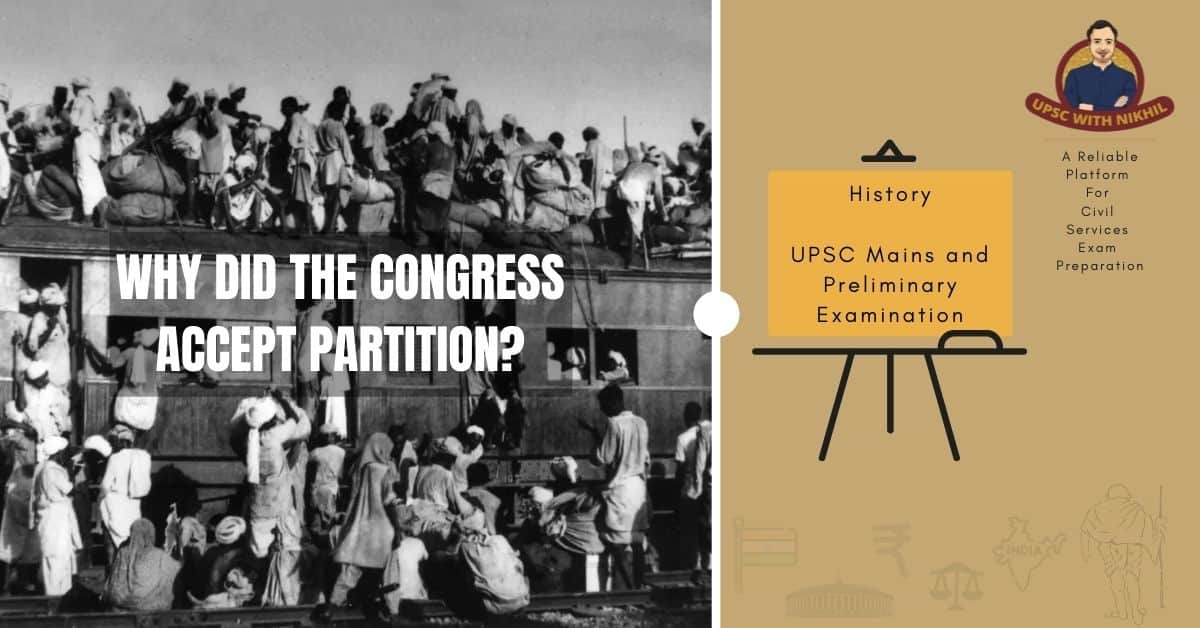
Why did the Congress agree to Partition and how did they do so? It's understandable that the League should demand it and gets its Shylocking pound of flesh, or that the British should concede it because they can't get out of their own web. But why the Congress, which was devoted to the idea of one Indian nation, accepted the country's division is a difficult question to answer.

• Gandhiji's advice is said to have been disregarded, and it's been suggested that he felt betrayed by his disciples and even wished to commit suicide, but he bravely fought communal strife alone, dubbed "a one man boundary force" by Mountbatten.

• It is often forgotten that in 1947, Nehru, Patel, and Gandhiji were only accepting what had become inevitable as a result of the Congress's long-term failure to engage the Muslim masses in the national movement and stem the surging waves of Muslim communalism, which had been pounding with increasing fury since 1937.
• The League's failure was highlighted in the 1946 elections, when it won 90 percent of Muslim seats. Despite the fact that the war against Jinnah had been lost by early 1946, the defeat was not acknowledged until the final battle was fought mercilessly on the streets of Calcutta and Rawalpindi, as well as the backstreets of Noakhali and Bihar.
• By June 1947, Congress leaders believed that the only way to prevent the spread of Direct Action and communal unrest was to transfer power immediately. Pakistan appeared to be an unavoidable reality after the Interim Government's virtual collapse.
• In a meeting of the AICC on June 14, 1947, Patel argued that we must accept the fact that Pakistan was operating in Punjab, Bengal, and the Interim Government. Nehru was appalled by the Interim Government's transformation into a battleground.
• Ministers squabbled, met separately to make decisions, and Finance Member Liaquat Ali Khan stymied the other ministries' operations. In the face of the Interim Government's inability to prevent Governors from aiding the League, and the Bengal provincial Ministry's inaction and even complicity in riots, Nehru wondered if there was any point in staying in power while people were being slaughtered.
• Immediate transfer of power would at the very least mean the establishment of a government capable of exercising the control it was now expected to wield but unable to do so. Accepting the immediate transfer of power to two dominions had another consideration.
• Balkanization was ruled out because provinces and princes were not given the option of independence; instead, they were cajoled and coerced into joining one of the two dominions, much to their chagrin. This was a huge accomplishment. Standing out among the princely states would have been a more serious blow to Indian unity than Pakistan was.
• Partition's acceptance in 1947 was merely the culmination of a series of incremental concessions to the League's intransigent support for a sovereign Muslim state. At the time of the Cripps Mission in 1942, the autonomy of Muslim majority provinces was accepted.
• In his 1944 talks with Jinnah, Gandhiji went one step further and accepted the right of Muslim majority provinces to self-determination. In June 1946, Congress acknowledged the possibility of Muslim majority provinces (Group B and C of the Cabinet Mission Plan) forming their own Constituent Assembly, but opposed compulsory grouping and upheld NWFP and Assam's right to refuse to join their groups if they so desired. However, by the end of the year, Nehru had stated that he would accept the Federal Court's decision on whether grouping was mandatory or optional. The Congress accepted the British Cabinet's clarification in December 1946 that grouping was mandatory without reservation.
• The Congress first mentioned Partition in early March 1947, when the Congress Working Committee passed a resolution stating that if the country was divided, Punjab (and, by extension, Bengal) must be partitioned. In June 1947, Congress accepted Partition under the 3rd June Plan, which was the final act of surrender to the League's demands.
• The leaders' valiant words stood in stark contrast to the Congress's tragic retreat. While proclaiming the Constituent Assembly's sovereignty, the Congress quietly accepted compulsory grouping and handed over the NWFP to Pakistan.
• Similarly, the Congress leaders eventually accepted Partition because they were unable to prevent communal riots, but their words were all about refusing to succumb to violence's blackmail. ‘We are not going to shake hands with murder or allow it to determine the country's policy,' Nehru wrote to Wavell on August 22, 1946.
• Millions of people on both sides of the new border refused to accept Partition's finality long after it was announced, and this is one of the main reasons why the population transfer became such a frantic, last-minute affair.
• The Congress position, particularly Nehru's, was characterized by wishful thinking, clinging to fond hopes, and a certain lack of understanding of the dynamics of communal feeling. The Congress granted the right of secession because it was believed that "the Muslims would not exercise it, but rather use it to shed their fears."

• It was not realised until the mid-1940s that what was on display was not the communalism of the 1920s or even the 1930s, when minority fears were being systematically stoked, but an assertive ‘Muslim nation,' led by an obstinate leader, determined to have a separate state by any means.
• As a result, rather than cutting the ground from under the communalists' feet, each concession made by the Congress only strengthened their position as success drew more Muslims to them. When Jinnah saw that Congress was giving in, he raised the stakes for his claim. Hindu communalism gained a foothold by portraying itself as the true defender of Hindu interests, which the Congress, it claimed, was sacrificing on the altar of unity.
• Another unrealistic hope was that after the British left, differences would be patched up and a free India would be built by Hindus and Muslims working together. This belief undervalued communalism's autonomy at the time — it was no longer dependent on the British for support; in fact, it had thrown away that crutch and was assertively independent, defying even the British.
• Another cherished hope was that Partition would be only temporary, that it would be reversible once communal passions subsided and sanity returned. Partition had become unavoidable due to the current psyche of Hindus and Muslims, but it would be reversible once communal passions subsided and sanity returned. People would not be able to live in Pakistan for long if they refused to accept Partition in their hearts, Gandhiji often said.
• Given what happened, the most implausible belief was that Partition would be peaceful. There were no riots expected. There were no planned population transfers because it was assumed that once Pakistan was ceded, there would be nothing left to fight over.
Despite the riots that plagued India from August 1946 onwards, Nehru maintained his faith in the goodness of his people. The hope was that a clean surgical cut would exorcise the madness. However, the body was so ill, and the instruments used were infected, that the operation went horribly wrong. Partition would be accompanied by even worse horrors than those that had preceded it.