

Chairman And Deputy Chairman Of Rajya Sabha
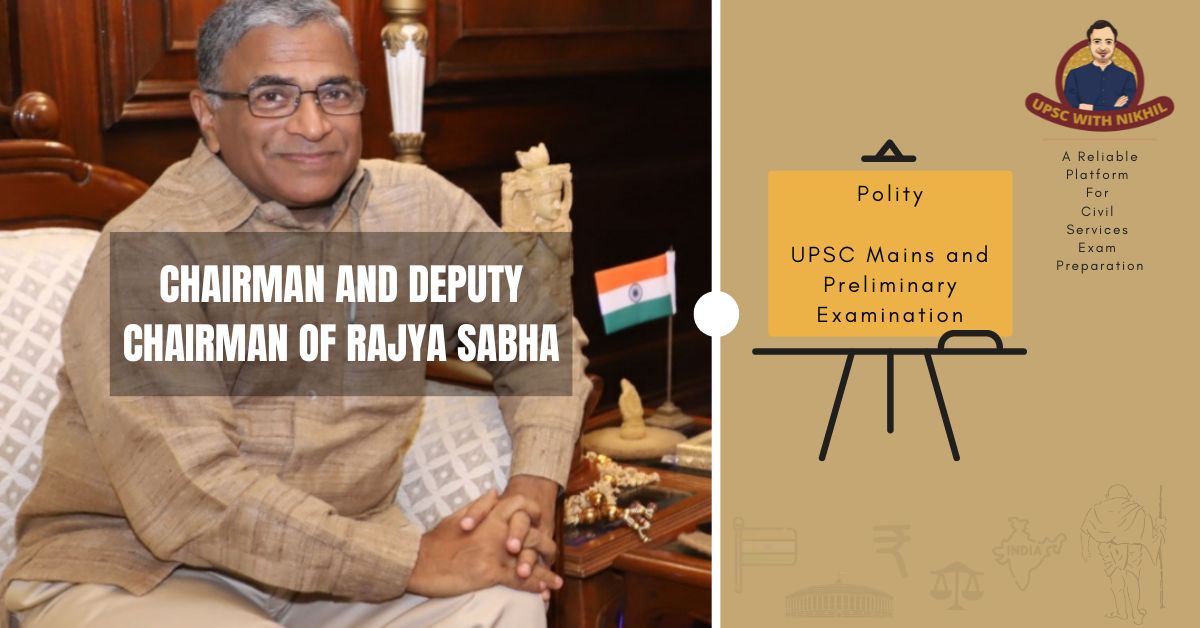
The Chairman of the Rajya Sabha is the presiding officer. The Vice-President of India is the Rajya Sabha's ex-officio Chairman. The Vice-President does not perform the duties of the Chairman of the Rajya Sabha during any period when he acts as President or discharges the functions of the President.

The Chairman of the Rajya Sabha can only be dismissed from his position if the Vice-President is also removed. The Chairman of the Rajya Sabha has comparable rights and functions to the Speaker of the Lok Sabha as a presiding officer. The Speaker, on the other hand, has two specific powers that the Chairman does not have:
• The Speaker determines whether or not a bill is a money bill, and his decision is final.
• A joint session of two Houses of Parliament is presided over by the Speaker.
The Chairman, unlike the Speaker (who is a House member), is not a member of the House. The Chairman, like the Speaker, is unable to vote in the first instance. In the event of a tie vote, he can also cast a vote. When a motion for his removal is under consideration, the Vice-President cannot preside over a Rajya Sabha sitting as Chairman. Even at such a time, he can be present and speak in the House, as well as participate in its procedures without voting (while the Speaker canvote in the first instance when a resolution for his removal is under consideration of the Lok Sabha). The Chairman's salary and allowances are set by Parliament in the same way that the Speaker's are. They are deducted from the Consolidated Fund of India and hence are not subject to Parliament's annual approval. The Vice-President is not entitled to any salary or stipend payable to the Chairman of the Rajya Sabha during any period while he acts as President or performs the powers of the President. During this period, however, he is paid the President's salary and allowance.
Deputy Chairman of Rajya Sabha
The Rajya Sabha elects the Deputy Chairman from among its own members. When the position of Deputy Chairman becomes empty, the Rajya Sabha elects a new member to fill it. In any of the following three situations, the DeputyChairman vacates his position:

• If he is no longer a Rajya Sabha member;
• If he submits a letter of resignation to the Chairman; and
• If he is removed from office by a resolution passed by a majority of the Rajya Sabha members. Only 14 days' notice is required for such a resolution to be moved.
When the Chairman's office is vacant, or when the Vice-President acts as President or fulfils the powers of the President, the Deputy Chairman takes over. When the Chairman is unable to attend a House meeting, he fills in for him. In both circumstances, he has all of the Chairman's powers.
It is important to note that the Deputy Chairman is not a subordinate of the Chairperson. He has direct accountability to the Rajya Sabha. While presiding over the House, the Deputy Chairman, like the Chairman, is unable to vote in the first instance; he can only cast a tie-breaking vote. Furthermore, if the House is considering a resolution to remove the Deputy Chairman, he is not permitted to preside over a House meeting, even if he is present.
When the Chairman preside over the House, the Deputy Chairman acts in the same capacity as any other member of the House. He has the right to speak in the House, participate in its procedures, and vote on any issue that comes before it. The Deputy Chairman is entitled to a regular salary and allowance, much like the Chairman. Parliament sets the amount, which is deducted from the Consolidated Fund of India.
Panel of Vice-Chairpersons of Rajya Sabha
The Chairman of the Rajya Sabha nominates a panel of vice-chairpersons from among the members, according to the Rajya Sabha Rules. In the absence of the Chairman or the Deputy Chairman, any of them can preside over the House. When presiding, he has the same powers as the Chairman. Until a new panel of vice-chairpersons is nominated, he remains in office.
When a member of the panel of vice-chairpersons is also absent, the House appoints someone else to act as Chairman. It is important to note that while the Chairman or Deputy Chairman positions are vacant, a member of the panel of vice chairpersons cannot preside over the House. During that time, the Chairman's responsibilities are to be carried out by any member of the House that the President may appoint for the purpose. To fill the vacated positions, elections are held as quickly as practicable.

Secretariat of Parliament
Each House of Parliament has its own secretarial staff, while there are some positions that are shared by both Houses. Parliament regulates their recruitment and service conditions. Each House's secretariat is led by a secretary-general. He is a permanent officer appointed by the House's presiding officer.