

Chief Minister Of The State
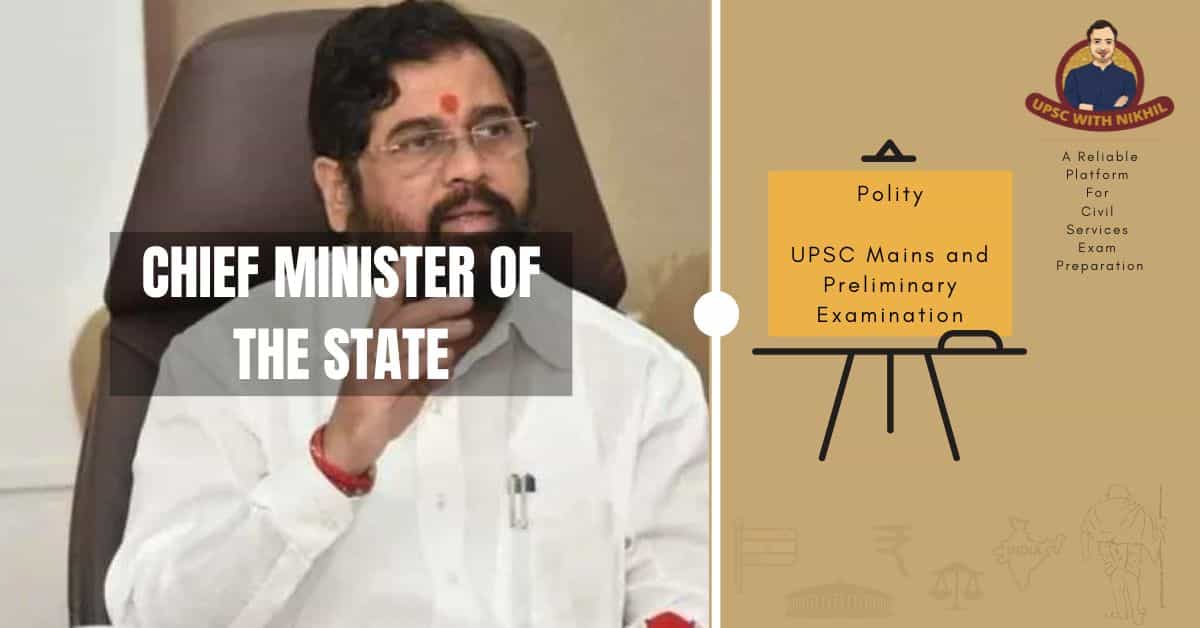
The position of Chief Minister at the state level is comparable to that of Prime Minister at the national level.
How the Chief Minister is Appointed?

The procedure for selecting and appointing the ChiefMinister is not specified in the Constitution. The Governor must appoint the Chief Minister, according to Article 164. This does not, however, imply that the governor can appoint anyone as Chief Minister. According to the conventions of the parliamentary system of government, the governor must appoint the Chief Minister as the leader of the majority party in the state legislative assembly. However, if no single party has a clear majority in the legislature, the governor may choose and appoint the Chief Minister at his discretion. In such a case, the governor usually appoints the Chief Minister as the leader of the assembly's largest party or coalition, and instructs him to seek a vote of confidence in the House within a month.
When the Chief Minister in office dies unexpectedly and there is no obvious successor, the governor may have to use his discretion in selecting and appointing the Chief Minister. On the other hand, when a Chief Minister dies, the ruling party usually elects a new leader, and the governor has no choice but to appoint him.
Before being appointed as Chief Minister, a person is not required by the Constitution to show that he has a majority in the legislative assembly. The governor could appoint him as Chief Minister first, and then ask him to prove his majority in the legislative assembly within a reasonable time frame. This has been done in a number of instances.
A person who is not a member of the state legislature can be appointed Chief Minister for a period of six months, after which he must be elected to the state legislature, failing which he loses his position.
The Chief Minister may be a member of either of the two Houses of a state legislature, according to the Constitution. Chief Ministers are usually chosen from the Lower House (legislative assembly), but a member of the Upper House (legislative council) has also been appointed on several occasions.

What is the Term and Salary of a Chief Minister?
The Chief Minister's term is not fixed, and he serves at the pleasure of the governor. This does not, however, preclude the governor from dismissing him at any time. He can't be fired by the governors as long as he has the support of the legislative assembly's majority. However, if the assembly loses confidence in him, he must resign or face dismissal by the governor.
The state legislature determines the Chief Minister's salary and allowances. He receives a sumptuary allowance, free housing, travel allowance, medical facilities, and other benefits in addition to his salary and allowances as a member of the state legislature.
What are the Powers and Functions of Chief Minister of State?
As the head of the state council of ministers, the Chief Minister has the following powers:
• Only those ministers are appointed by the governor who have been recommended by the Chief Minister.
• He shuffles and reshuffles ministerial portfolios.
• In the event of a disagreement, he can ask a minister to resign or advise the governor to dismiss him.
• He preside over the council of ministers' meetings and has a say in its decisions.
• He directs, controls, and coordinates all of the ministers' activities.
• By resigning from office, he can bring the council of ministers to its knees. Because the ChiefMinister is the head of the council of ministers, his resignation or death will result in the council of ministers being dissolved. Any other minister's resignation or death, on the other hand, simply creates a vacancy, which the Chief Minister may or may not wish to fill.
In relation to the governor, the Chief Minister has the following powers:
• He serves as the governor's primary point of contact with the council of ministers.
It is the Chief Minister's responsibility to:
• to communicate to the Governor of the state all decisions made by the council of ministers concerning the administration of the state's affairs, as well as legislative proposals;
• to provide the governor with any information or legislative proposals relating to the administration of the state's affairs; and
• if the governor so directs, to submit any matter on which a minister has made a decision but which has not been considered by the council to the council of ministers for consideration.
• He advises the governor on important appointments such as the attorney general, the chairman and members of the state public service commission, the state election commissioner, and so on.
As the House's leader, the Chief Minister has the following powers:
• He advises the governor on the summoning and proroguing of the state legislature's sessions.
• He has the authority to recommend to the governor the dissolution of the legislative assembly at any time.
• On the floor of the House, he announces the government's policies.

In addition, the Chief Minister has the following responsibilities:
• He is the State Planning Board's chairman.
• By rotation, he serves as vice-chairman of the concerned zonal council, holding office for one year at a time.
• He is a member of the Prime Minister's Inter-State Council and the National Development Council.
• He is the state government's chief spokesman.
• In times of crisis, he serves as the chief crisis manager at the political level.
• As the state's leader, he meets with various groups of people and receives memos from them about their problems, among other things.
• He is the political head of the services.
As a result, he plays a vital and important role in the state administration. The governor's discretionary powers, on the other hand, limit the Chief Minister's power, authority, influence, prestige, and role in the state administration.