

Composition Of The Parliament Of India
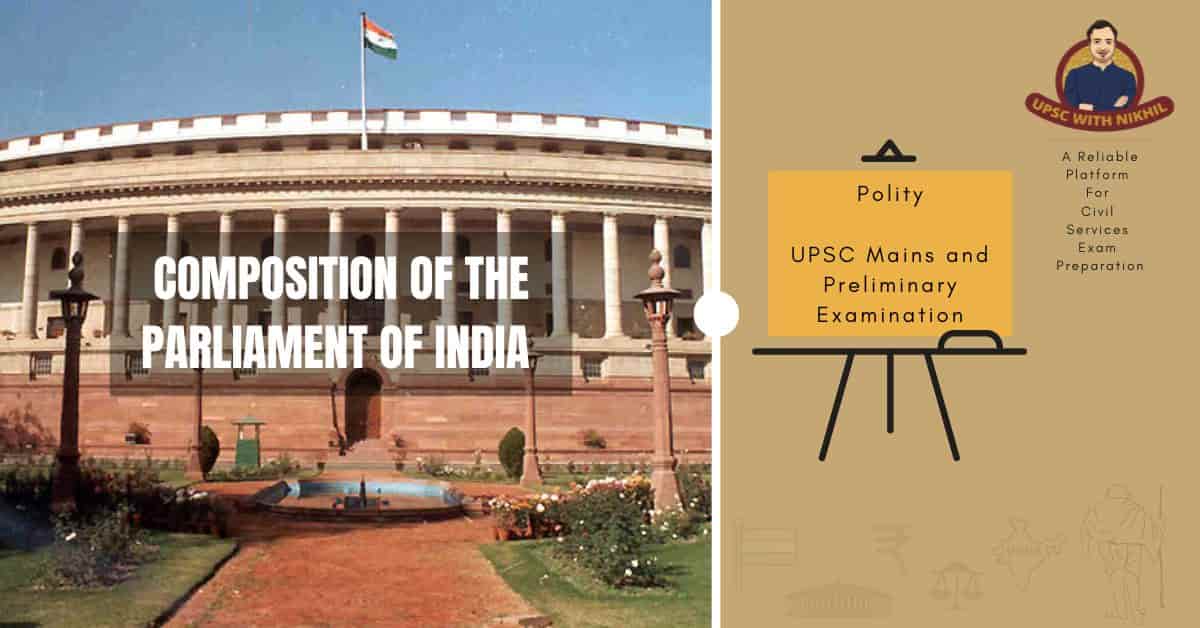
The Indian Parliament is divided into three sections by the Constitution: the President, the Council of States, and the House of People. The Council of States and the House of People, respectively, adopted the Hindi names 'Rajya Sabha' and 'Lok Sabha' in 1954. The Rajya Sabha (Second Chamber or House of Elders) is the Upper House, whereas the Lok Sabha is the Lower House (First Chamber or Popular House). The former represents the Indian Union's states and union territories, while the latter represents the Indian people as a whole.
Despite the fact that the President of India is not a member of either House of Parliament and does not attend its meetings, he is an important part of it. This is because without the President's assent, a bill enacted by both Houses of Parliament cannot become law. He also fulfils various tasks related to Parliamentary processes, including as summoning and prorogueing both Houses, dissolving the Lok Sabha, addressing both Houses, and issuing ordinances when they are not in session, among other things.
The interdependence of the legislative and executive departments is emphasised in the parliamentary form of government. As a result, we have the 'President in-Parliament,' similar to the 'Crown-in-Parliament,' in the United Kingdom. On the other hand, the presidential system of government emphasises the separation of legislative and executive powers. As a result, the American president is not considered a member of Congress.
Who Sits in the Rajya Sabha And Lok Sabha?

Composition of Rajya Sabha
The Rajya Sabha has a maximum strength of 250 members, with 238 being representatives from states and union territories (elected indirectly) and 12 being nominated by the president. The Rajya Sabha currently has 245 members. Two hundred and twenty-nine members represent the states, four members represent the union territories, and twelve members are president-nominated. The Fourth Schedule of the Constitution governs the distribution of Rajya Sabha seats among the states and union territories.
State Representation in the Rajya Sabha: State representatives in the Rajya Sabha are elected by state legislative assemblies. The election is held according to the proportional representation system, with a single transferable vote. In the RajyaSabha, seats are allocated to states based on their population. As a result, the number of representatives varies each state. Uttar Pradesh, for example, has 31 members, whilst Tripura only has one. In the United States, however, all states, regardless of population, are given equal representation in the Senate. There are 50 states in the United States, and the Senate has 100 members, two from each state.
Union Territory Representation in the Rajya Sabha: Members of an electoral college particularly established for the purpose elect the representatives of each union territory in the Rajya Sabha in an indirect election. This election is also being held under a proportional representation system with a single transferable vote. Only two of the seven union territories have representation in the Rajya Sabha (Delhi and Puducherry). The remaining five union territories have too little a population to have a representative in the Rajya Sabha.
Members of the Rajya Sabha who have special knowledge or practical experience in art, literature, science, or social service are nominated by the president. The rationale behind this nomination principle is to provide distinguished people a seat in the Rajya Sabha without having to go through the electoral process. It's worth noting that there are no nominated members of the American Senate.
Composition of Lok Sabha
The Lok Sabha's maximum strength is set at 552. There will be 530 members representing the states, 20 members representing the union territories, and two members representing the Anglo-Indian community who will be nominated by the president. The Lok Sabha currently has 545 members. 530 members represent the states, 13 members represent the union territories, and the President nominates two Anglo-Indian members.

State Representation: State members in the Lok Sabha are directly chosen by the people from the states' territorial seats. The election is based on the universal adult franchise premise. Every Indian citizen over the age of 18 who is not disqualified by the rules of the Constitution or any legislation is eligible to vote in such an election. The 61st Constitutional Amendment Act of 1988 decreased the voting age from 21 to 18 years.
Union Territory Representation: The Constitution empowers Parliament to specify the method for electing union territory MPs to the Lok Sabha. As a result, the Union Territories (Direct Election to the House of the People) Act, 1965, was adopted, allowing members of the Lok Sabha from the union territories to be elected directly. Nominated Members: If the Anglo-Indian community is underrepresented in the Lok Sabha, the president can nominate two members from the group. This clause was supposed to last until 1960, but the 95th Amendment Act of 2009 extended it until 2020.
Who is Called as Leader Of The House?
The prime minister, if he is a member of the Lok Sabha, or a minister who is a member of the Lok Sabha and is nominated by the prime minister to serve as the Leader of the House, is the 'Leader of the House,' according to the Lok Sabha Rules. In the Rajya Sabha, there is also a 'Leader of the House.' He is a minister and a member of the Rajya Sabha, and the prime minister has nominated him to serve in that capacity. In either House, the leader of the house is a key functionary who has direct control over how business is conducted. He also has the power to appoint a House deputy leader. In the United States, the same official is known as the'majority leader.'
Who is Leader of The Opposition?

There is a 'Leader of the Opposition' in each House of Parliament. The leader of the largest Opposition party with at least one-tenth of the total number of seats in the House is recognised as the Opposition Leader in that House. The leader of the opposition has a key role to play in a parliamentary form of governance. His main responsibilities are to provide constructive critique of the government's policies and to offer an alternative government. As a result, in 1977, the leader of the Opposition in the Lok Sabha and the Rajya Sabha received formal status. They are also entitled to the same pay, allowances, and other benefits as cabinet ministers. For the first time, a formal head of the opposition was recognised in 1969. In the United States, the same functionary is known as the'minorityleader.'
The 'Shadow Cabinet' is a unique institution in the British political system. The Opposition Party established it to help balance the ruling government and prepare its members for future ministerial positions. Almost every member of the ruling government is'shadowed' by a comparable member of the opposing cabinet in this shadow cabinet. If the government changes, this shadow cabinet serves as the 'alternative cabinet.' That is why Ivor Jennings referred to the Opposition Leader as the "alternative Prime Minister." He is compensated by the government and has the status of a minister.
What is Whip?
The offices of the Speaker of the House and the Leader of the Opposition are referenced in the Rules of the House and the Parliamentary Statute, respectively, while they are not mentioned in the Indian Constitution.
The office of 'whip,' on the other hand, is not mentioned in the Indian Constitution, the House Rules, or any Parliamentary Statute. It is based on the parliamentary government's conventions. In Parliament, each political party, whether ruling or opposition, has its own whip. The political party has appointed him as a deputy floor leader. He is in charge of ensuring that a big number of his party's members attend meetings and winning their support for or against a certain subject. He supervises and governs their behaviour in the House of Commons. The members are expected to follow the whip's instructions. Disciplinary action may be imposed if this does not occur.