

Election Of The President Of India
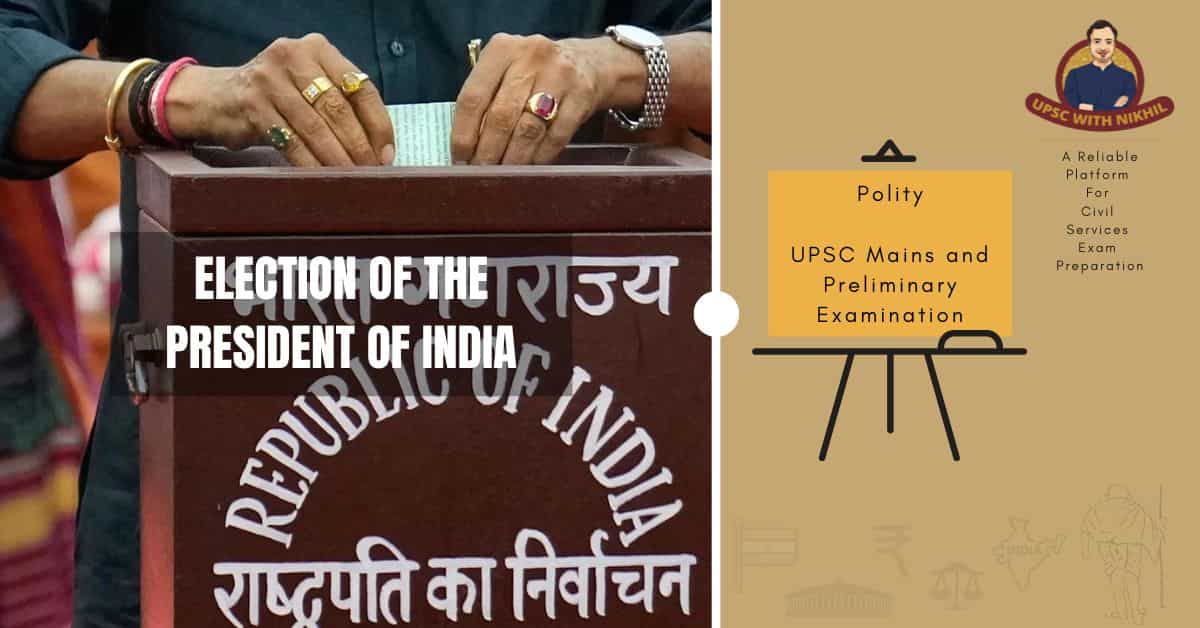
The President of India is qualified, elected, and impeached under Chapter I (The Executive) of Part V of the Constitution (The Union). Part V of the Constitution deals with the Union executive from Articles 52 to 78. The President, Vice-President, Prime Minister, Council of Ministers, and Attorney General of India make up the Union executive. The President of India is the country's leader. He is India's first citizen and serves as a symbol of the country's unity, integrity, and solidarity.
How The President Of India Is Elected?

The President is chosen by members of the Electoral College, which includes the following individuals:
1) The elected members of both the Houses of Parliament;
2) The elected members of the legislative assemblies of the states; and
3) The elected members of the legislative assemblies of the Union Territories of Delhi and Puducherry
As a result, nominated members of both Houses of Parliament, nominated members of state legislative assemblies, members (both elected and nominated) of state legislative councils (in the case of a bicameral legislature), and nominated members of the Legislative Assemblies of Delhi and Puducherry do not vote in the presidential election. Even if new elections to the dissolved assembly are not held before the presidential election, members of the dissolved assembly lose their eligibility to vote in the presidential election. At the election of the President, the Constitution requires uniformity in the scale of representation of different states, as well as parity between the states as a whole and the Union. To do so, the number of votes that each elected member of each state's legislative assembly and the Parliament is entitled to cast at such an election will be determined as follows:
1. Each elected member of a state's legislative assembly is entitled to the same number of votes as the number of multiples of one thousand in the quotient obtained by dividing the state's population by the total number of elected members of the assembly. This can be stated as follows:
2. Each elected member of either House of Parliament shall have the number of votes determined by dividing the total number of votes assigned to members of the state legislative assemblies by the total number of elected members of both Houses of Parliament. This can be stated as follows:
The President of the United States is elected using a proportional representation system with a single transferable vote and secret ballot voting. This system ensures that the winning candidate receives an absolute majority of the vote. To be declared elected to the office of President, a candidate must receive a certain number of votes. The quota of votes is calculated by dividing the total number of valid votes cast by the number of candidates to be elected (in this case, only one candidate is running for President) plus one, then adding one to the quotient. The formula can be written as follows:

Only one ballot paper is given to each member of the Electoral College. The voter must indicate his preferences by marking 1, 2, 3, 4, etc. against the names of candidates when casting his vote. This means that the voter can select as many candidates as there are in the race. The first preference votes are counted in the first phase. In this phase, if a candidate receives the required quota, he is declared elected. Otherwise, the procedure for transferring votes will begin. The ballots of the candidate who receives the fewest first preference votes are void, and his second preference votes are transferred to other candidates' first preference votes. This procedure is repeated until a candidate obtains the required quota.
Furthermore, at least 50 electors as proposers and seconders must sign a petition nominating a candidate for President. Every candidate must deposit Rs 15,000 in the Reserve Bank of India as a security deposit. If the candidate receives less than one-sixth of the votes cast, the security deposit will be forfeited.
Before 1997, there were ten proposers and seconders for each proposal, and the security deposit was Rs 2,500. They were increased in 1997 to deter non-serious candidates.
Constitutional Assembly Debates –Presidential Election
Some members of the Constituent Assembly criticised the President's indirect election system as undemocratic and proposed a direct election system instead. The indirect election was chosen by the Constitution makers for the following reasons:
1. The indirect election of the President is consistent with the Constitution's parliamentary system of government. The president is only a ceremonial executive in this system, and the real power is vested in the council of ministers, which is led by the prime minister. It would have been unprecedented to have the President elected directly by the people without conferring any real power on him.
2. Due to the vast size of the electorate, a direct election of the President would have been extremely costly, time-consuming, and energy-intensive. Given that he is only a symbolic head, this is unjustified. Some Constituent Assembly members proposed that the President be chosen solely by the members of the two Houses of Parliament. The framers of the Constitution did not want this because a Parliament dominated by one political party would almost certainly choose a candidate from that party, and such a President could not represent the Indian Union's states. Under the current system, the President is equally representative of the Union and the states. Furthermore, it was pointed out in the Constituent Assembly that in the case of presidential elections, the term "proportional representation" is a misnomer. When two or more seats must be filled, proportionalrepresentation is used. There is only one vacancy in the position of President. It's more accurately referred to as a preferential or alternative vote system. Similarly, the term "single transferable vote" was criticised because no voter has a single vote; instead, each voter has multiple votes.
What Are The Qualifications For Election As President?

To be eligible for election as President, a person must meet the following requirements:
1. He must be an Indian citizen.
2. He should have reached the age of 35.
3. He must be eligible to run for election to the Lok Sabha.
4. He should not hold a profit-making position in the federal government, a state government, a local government, or any other public authority.
Note: A sitting President or Vice-President of the United States, the Governor of any state, or a minister of the United States or any state is not considered to hold a profit-making office and thus is not eligible to run for President.