

Freedom Of Conscience, Profession, Practice & Propagation
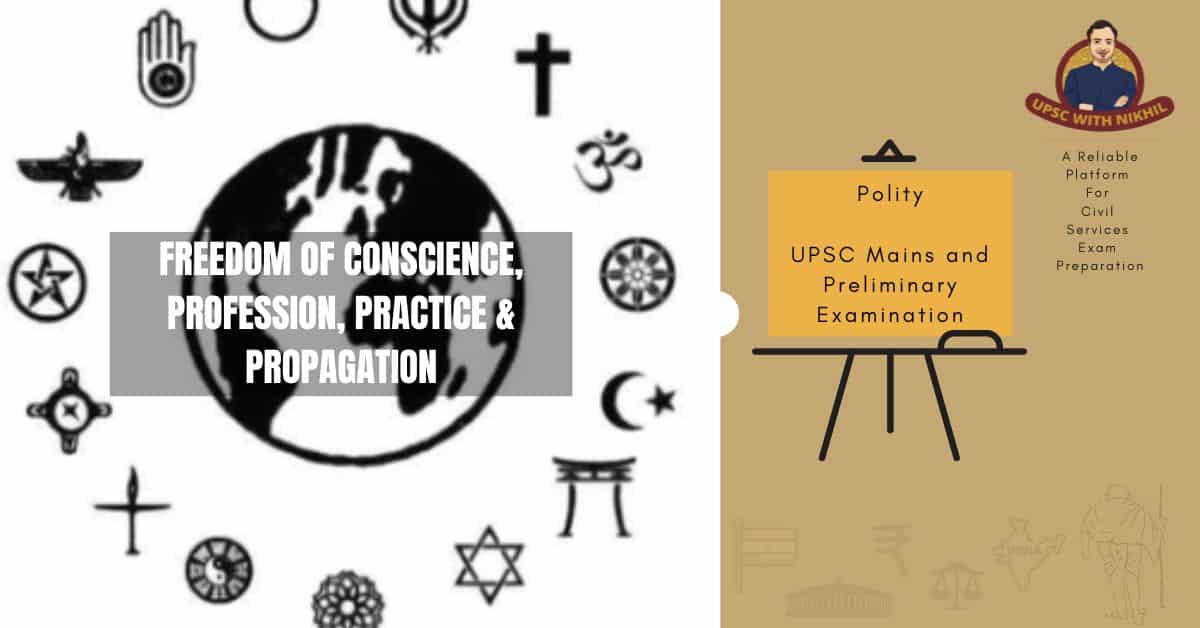
Article 25 of the Indian constitution guarantees religious freedom, including the right to freely profess, practise, and propagate religion. It goes like this:
What Is The Message of Article 25 of The Constitution?
Freedom of conscience, profession, practise and propagation of religion
(1) Subject to public order, morality and health and to the other provisions of this Part, all persons are equally entitled to freedom of conscience and the right freely to profess, practise and propagate religion
(2) Nothing in this article shall affect the operation of any existing law or prevent the State from making any law (a) Regulating or restricting any economic, financial, political or other secular activity which may be associated with religious practise;

(b) Providing for social welfare and reform or the throwing open of Hindu religious institutions of a public character to all classes and sections of Hindus Explanation I -The wearing and carrying of kirpans shall be deemed to be included in the profession of the Sikh religion Explanation II- In sub clause
(c) of clause reference to Hindus shall be construed as including a reference to persons professing the Sikh, Jaina or Buddhist religion, and the reference to Hindu religious institutions shall be construed accordingly.
Is religion defined in the Constitution?
The term "religion" isn't defined in the Constitution, and it's hard to come up with a strict definition. In a number of cases, the Supreme Court has defined it. A religion is unquestionably a matter of faith, but it is not always theistic. Religion is founded on "a system of beliefs or doctrines that those who profess that religion regard as conducive to their spiritual well-being," but it would be incorrect to say that religion is nothing more than a doctrine or belief. A religion may prescribe rituals and observances, ceremonies and modes of worship that are regarded as integral parts of religion, and these forms and observances may extend even to matters of food and dress for its followers to accept.
Article 25 confers a fundamental right on every person not only to entertain such religious beliefs as may be approved by his judgement or conscience, but also to exhibit his beliefs and ideas through overt acts and practises sanctioned by his religion, subject to certain limitations. What practises are now protected under the Article will be decided by the courts based on the doctrine of a particular religion, and will include practises that are considered part of the community's religion. To determine the legal status of a practise, courts have looked to religious scriptures.
According to Article 25, everyone has the right to freedom of conscience and to freely profess, practise, and propagate religion. These have the following ramifications:
(a) Conscience freedom: An individual's inner freedom to shape his relationship with God or Creatures in any way he wishes.
(b) Right to profess: The right to openly and freely declare one's religious beliefs and faith.
(c) Right to practise: Religious worship, rituals, and ceremonies, as well as the public display of beliefs and ideas.
(d) The right to propagate: The transmission and dissemination of one's religious beliefs to others, as well as the exposition of one's religion's tenets. It does not, however, include the right to convert others to one's own religion. Forcible conversions violate the right to "freedom of conscience" guaranteed to all people.
It is clear from the foregoing that Article 25 covers both religious beliefs (doctrines) and religious practises (rituals). Furthermore, these rights are available to all people, both citizens and non-citizens. These rights, however, are limited by public order, morality, health, and other fundamental rights provisions.
What is freedom of conscience in Indian Constitution?
Freedom of 'conscience' refers to the citizen's absolute inter freedom to shape his own relationship with God in any way he sees fit. The courts have defined freedom of conscience as a person's right to hold any belief or doctrine about matters that he or she considers to be beneficial to his or her spiritual well-being.
what is Freedom to Profess of Religion?
To "profess" a religion is to declare one's faith and beliefs freely and openly. The constitutional right to profess religion refers to the right to publicly display one's religion through overt acts such as teaching, practising, and observing religious precepts and ideals without the explicit intent of propagation. Taking part in religious processions, worshipping in public places, and wearing specific garments all fall under the umbrella of religious profession. The wearing and carrying of kirpans is permitted under the Indian Constitution as part of the Sikh religion's profession.
The appellants in the Quareshi case argued that sacrificing a cow on BakrId day constituted a religious practise protected by Article 25 of the Constitution. “We have, however, no material on the record before us, which will enable us to say... that the sacrifice of a cow on that day is an obligatory overt act for a Mussalman to exhibit his religious belief and idea,” the Supreme Court said, tracing the history of the custom of offering a cow sacrifice on Bakr-Id day.
"The right to hold religious processions and gatherings in public places falls under the right to profess religion, which is guaranteed in article 25." (1). However, the exercise of this right is constrained by public order and morality. The police, for example, have been given the authority to regulate such overt acts of religious profession. The police are authorised under Section 30 (1) of the Police Act to regulate assemblies and processions, as well as to prescribe their routes and timings. When a magistrate suspects a breach of the peace, he or she can use section 144 of the Code of Criminal Procedure to prohibit processions and meetings entirely. During times of communal tension, which is common in some parts of the country, such orders are issued. Prohibitive orders can also include the prohibition of the use of loudspeakers and other electronic devices used in religious profession and practise on some occasions of communal and public disturbances.
The protection provided by article 25 (1), on the other hand, does not absolve citizens of their responsibility to work with the government to maintain public order so that people can go about their daily lives in dignity.
What Is The Meaning Of Freedom To Practice A Religion?

To 'practise' religion means to carry out religious duties, rights, and rituals as prescribed by the religious order in which one believes, as well as to demonstrate one's religious belief and ideas through acts as prescribed by the religious order in which one believes. Article 25 (1) of the Indian Constitution guarantees the freedom to practise religion.
According to the Supreme Court's definition, an act is a religious practise that is protected under clause (1) of Article 25 of the Indian Constitution insofar as it is considered an essential and integral part of a religion's tenet. The Court proposed this criterion in order to protect genuine religious practises from non-religious accretions and even superstitions. The criterion is that it must be regarded as an essential part of a religious community's religious tenet. The court is the proper forum to resolve any counterclaims by competing individuals or groups on this matter. In the Tilkayat case, this was demonstrated.
Dr. P.C. Jain, a constitutional expert, has suggested that in the case of doubtful religious practises, the Courts in India should accept the contention of a believer who claims before the Court that a certain practise has religious significance to the plaintiff rather than restoring to judicial prove plaintiff's claim so as to see if it is true.
Freedom to Propagate Religion
'Propagate' refers to the act of spreading and publicising one's religious beliefs for the benefit of others. However, the term "propagation" only refers to persuasion and exposition, not coercion, allurement, or inducement (post Stanislaus vs State of Madhya Pradesh). The right to spread one's religion does not imply the right to convert others to one's religion.
Violation of Article 25 And Can Freedom of Religion Be Restricted?
One of the most misunderstood articles of the Indian Constitution is Article 25. While it guarantees the freedom to practise and propagate any religion, it also imposes a responsibility to ensure that public order, morality, and health are not jeopardised in the process. This constitutional provision does not give individuals the right to perform religious rituals or animal sacrifices in a busy street or public place that causes others inconvenience. Similarly, Article 25 does not guarantee the use of loudspeakers in temples or mosques. Bursting fire crackers for religious occasions and using loudspeakers during religious prayers were scrutinised by the Supreme Court, which limited the time of cracker bursting and, in some cases, outright banned the sale of crackers as well as cracker bursting on certain days of the year.