

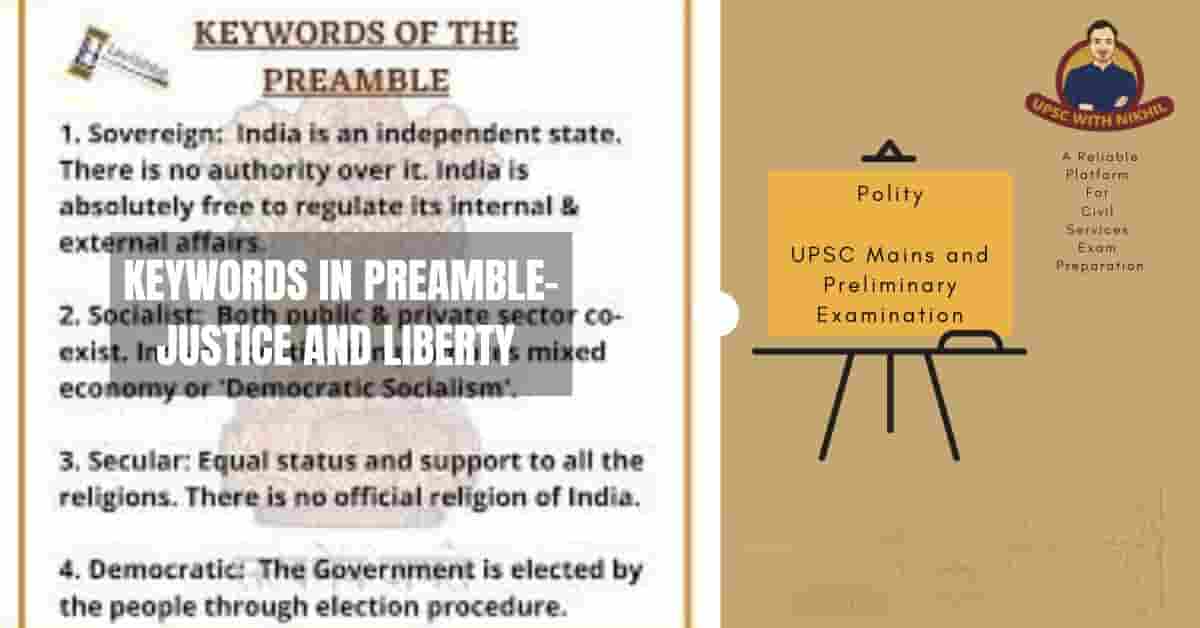
Keywords In Preamble-justice And Liberty
WHAT IS JUSTICE?
The preamble of India's constitution pledges to provide political, economic, and social justice to all of the country's citizens. Social justice refers to the elimination of all forms of inequity, including those resulting from disparities in wealth, opportunity, status, race, religion, caste, and title. Part IV of the constitution lays out the state's directives in order to achieve this ideal of social justice.

The Supreme Court stated in Air India Statutory Corporation v. United Labor Unionthat the goal of social justice was to achieve a substantial degree of social, economic, and political equality, which was the legitimate expectation and constitutional goal. It was held that social justice was a dynamic device for alleviating the sufferings of the poor, weak, Dalits, tribals, and other deprived sections of society and elevating them to a level of equality, allowing them to live a life of dignity.
The term "economic justice" refers to fairness in terms of economic power. In layman's terms, it means that everyone, regardless of caste, gender, or social status, should be paid equally for equal work.
Political justice is defined as the absence of any arbitrary or unreasonable distinction between men in political matters. To ensure political justice, the constitution has adopted the universal adult suffrage system.
The term 'justice' refers to the harmonious integration of individual behaviour with society's overall well-being. When a person's action or behaviour benefits the community as a whole, it is said to be just. As a result, the pursuit of the common good, rather than the good of individuals, is the essence of justice. A welfare state's primary goal is justice, and its very existence is predicated on the parameters of justice.
WHAT IS LIBERTY?
The Indian constitution's preamble declares that freedom of belief, thought, expression, faith, and worship are essential for the development of individuals and the country. The absence of external impediments to movement is referred to as liberty or freedom. It denotes a lack of restraint. The power to do what the law permits is known as liberty.
According to Aristotle, liberty is presumed in democracy because it is widely held that no man is free under any other government. Liberty is a multi-stranded concept. There is no universally accepted definition of liberty, despite attempts by statesmen and judges, among others, to provide an all-encompassing definition. The word "liberty" in the Indian constitution's preamble does not simply mean "the absence of dominance restraint." The ‘right to liberty of thought, expression, belief, faith, and worship' is a positive concept.

"Liberty of thought, expression, belief, faith, and worship," as Acharya J.B Kriplani put it, "can only be guaranteed on the basis of nonviolence." The concept of liberty is inextricably linked to democracy. As a result, every member of a community must have certain basic rights in order to live in a free and civilised society. In a well-ordered society, no individual's liberty can be absolute or unrestricted.
It must be subject to social control in order to safeguard the collective interests of the individuals who make up the society. For example, crime prevention and investigation, as well as criminal prosecution. Liberty must not devolve into licence in order for democracy to survive. In his dissenting opinion in the Kartar Singh case, Justice Ramaswamy emphasised this.
A man's most prized possession is his liberty. The right to do something that the law permits is known as liberty. The existence of rights in every man has been recognised by the Constitution. “Liberty is confined and controlled by law, whether common law or statute. It is regulated freedom. It is not abstract or absolute freedom. The safeguards of liberty lie in the good sense of the people and in the system of representative and responsible government, which has been evolved. Liberty is itself the gift of law and may be the law forfeited abridged”.
"Liberty denotes not only freedom from bodily restraint but also the right of the individual to contract, engage in any of the common occupations of life, to acquire useful knowledge, to marry, establish a home, and bring up children, to worship God according to the dictates of his own conscience, and to enjoy those privileges long recognised at common law as essential to the orderly pursuit of happiness by free men," Meyer v. Nebraska stated.
"The sphere of my legal liberty is that sphere of activity within which the law is contend to leave me alone," writes John Salmond. Through its mechanisms, judiciary, and established rules of justiciability, the country's constitutional law has fully guaranteed liberty.