

Privileges And Immunities Of Parliament
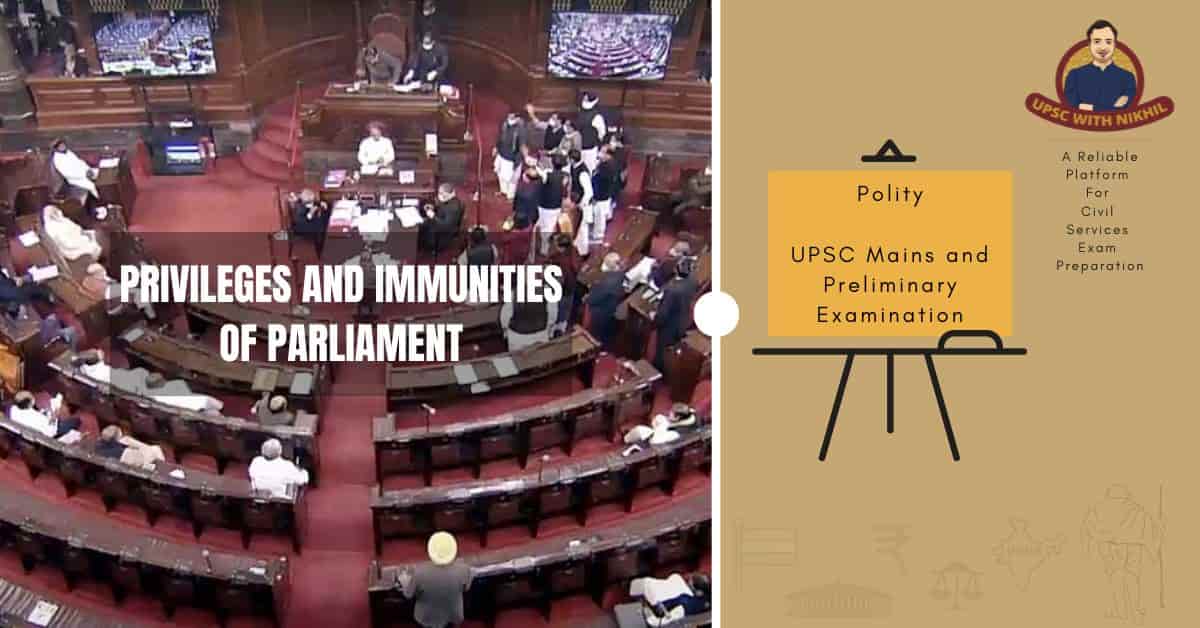
The two Houses of Parliament, their committees, and their members enjoy special rights, immunities, and exemptions known as parliamentary privileges. They are required in order to ensure their actions' independence and effectiveness. Without these privileges, the Houses would be unable to maintain their authority, dignity, and honour, as well as protect their members from any impediment in carrying out their parliamentary duties. Parliamentary privileges have also been extended to those who are entitled to speak and participate in the proceedings of a House of Parliament or any of its committees, according to the Constitution. The Attorney General of India and Union Ministers are among them.
It is important to note that the president, who is also a member of the Parliament, is not entitled to parliamentary privileges. There are two broad categories of parliamentary privileges:
1. Those that each House of Parliament enjoys collectively, and
2. Those that each member enjoys on their own.
What Are Collective Privileges?

The privileges that each House of Parliament has collectively are as follows:
Each house has the authority to publish its reports, debates, and proceedings, as well as the authority to prevent others from doing so. The 44th Amendment Act of 1978 restored the press's right to publish true accounts of parliamentary proceedings without the House's permission. This does not apply, however, in the case of a House secret session.
It has the power to keep strangers out of its meetings and hold secret meetings to discuss important issues.
It has the authority to make rules to govern its own procedure and conduct of business, as well as to adjudicate on such matters.
It has the power to reprimand, admonish, or imprison members and non-members who violate its privileges or treat it with contempt (also suspension or expulsion, in case of members).
It is entitled to immediate notification of a member's arrest, detention, conviction, imprisonment, and release.
It has the power to launch investigations, summon witnesses, and order the production of relevant documents and records.
The courts are not allowed to investigate the actions of the House or its committees.
Without the permission of the presiding officer, no one (whether a member or an outsider) can be arrested, and no legal process (civil or criminal) can be served within the House precincts.
What Are Individual Privileges?
Individual members have the following privileges:
They are not allowed to be arrested during a Parliamentary session, as well as 40 days prior to the start and 40 days after the end of a session. This privilege applies only to civil cases; it does not apply to criminal or preventive detention cases.
In Parliament, they have the right to free speech. No member of Parliament or its committees is liable in any court for anything said or voted in Parliament or its committees. This freedom is limited by the Constitution's provisions as well as the rules and standing orders that govern Parliamentary procedure.

They are not required to serve on juries. When Parliament is in session, they can refuse to give evidence and appear as a witness in a case that is pending in court.
What Is Consider as Breach of Privilege And Contempt of The House?
“When any individual or authority disregards or attacks any of the privileges, rights and immunities,either of the member individually or of the House in its collective capacity, the offence is termed as breachof privilege and is punishable by the House.”
Contempt of the House is defined as any act or omission that obstructs a House of Parliament, its member, or its officer in the performance of their functions, or that has the potential, directly or indirectly, to produce results that are detrimental to the House's dignity, authority, or honour. Though the terms 'breach of privilege' and 'contempt of the House' are frequently used interchangeably, their meanings are distinct. 'Normally, a violation of privilege is considered contempt of the House.' Similarly, contempt of the House can include a violation of privilege. However, contempt of the House has broader implications. It is possible to be in contempt of the House without committing a breach of privilege.' Similarly, ‘actions whichare not breaches of any specific privilege but are offences against the dignity and authority of the Houseamount to contempt of the House’. 30 Disobedience to a legitimate House order, for example, is not a breach of privilege, but can result in contempt of the House.
What Are The Sources of Privileges?

Originally, the Constitution (Article 105) stated two privileges: freedom of speech in Parliament and the right to publish the proceedings of that body. Other privileges were to be the same as those of the British House of Commons, its committees, and its members on the date of its establishment (i.e., January 26, 1950) until defined by Parliament. Other privileges of each House of Parliament, its committees, and its members are to be those that they had on the date of its commencement (i.e., June 20, 1979), unless otherwise defined by Parliament. This means that the status quo for other privileges remains unchanged. In other words, the amendment only changed the wording by removing a direct reference to the British House of Commons, but not the meaning of the provision.
It's worth noting that the Parliament has yet to enact any special legislation to fully codify all of the privileges. They are based on five sources, namely,
Constitutional provisions,
Various laws made by Parliament,
Rules of both the Houses,
Parliamentary conventions, and
Judicial interpretations.