

Right To Property: No Longer A Fundamental Right
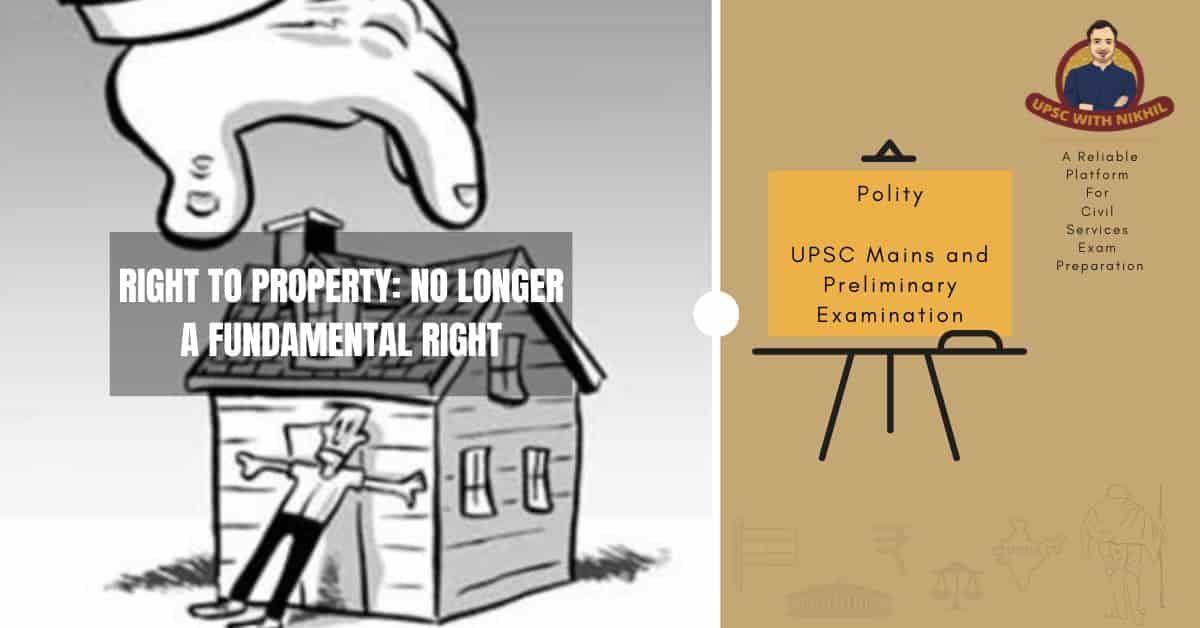
Property rights are not recognised as fundamental rights in the Indian Constitution. The 44th Amendment, passed in 1977, made the right to acquire, hold, and dispose of property no longer a fundamental right. However, Article 300 (A) was added to another section of the Constitution to state that no one's property can be taken away unless by law. As a result, the fundamental right to property has been replaced by a statutory right to property. The amendment increased the state's ability to seize property for social welfare purposes.

Part III of the Constitution established the right to property as one of the seven fundamental rights.
Article 19(1)(f) and Article 31 dealt with it. Every citizen has the right to acquire, hold, and dispose of property, according to Article 19(1)(f). Article 31 on the other hand, ensures that every person, whether citizen or non-citizen, has a right against property deprivation. It stated that no one's property can be taken away from them unless they have legal authority to do so. It gave the government the power to seize or requisition a person's property under two conditions: (a) it had to be for a public purpose, and (b) it had to include a payment of compensation (amount) to the owner.
The Fundamental Right to Property has been the most contentious since the Constitution's inception. It has resulted in disagreements between the Supreme Court and Parliament. It resulted in the 1st, 4th, 7th, 25th, 39th, 40th, and 42nd Amendments to the Indian Constitution. Articles 31A, 31B, and 31C have been added to the Constitution and modified from time to time to nullify the effect of Supreme Court judgments and to protect certain laws from being challenged on the basis of fundamental rights violations. The majority of the cases revolved around the state's obligation to pay compensation for the acquisition or requisition of private property.
When Was Right To Property Removed From Fundamental Rights?
As a result, by repealing Article 19(1)(f) and Article 31 from Part III, the 44th Amendment Act of 1978 abolished the right to property as a Fundamental Right. Instead, in Part XII, under the heading "Right to Property," the Act added a new Article 300A. It states that no one's property can be taken away from them unless they have legal authority to do so. As a result, the right to property is still a legal or constitutional right, but it is no longer a fundamental right. It is not a part of the Constitution's basic structure. The legal right to property (as opposed to the Fundamental Rights) has the following implications:
It can be regulated, i.e. limited, shortened, or modified, without requiring a constitutional amendment, by an ordinary law of the Parliament.

Private property is protected from executive action, but not from legislative action.
In the event of a violation, the aggrieved person cannot seek enforcement directly from the Supreme Court under Article 32 (right to constitutional remedies, including writs). Under Article 226 of the Constitution, he has the right to petition the High Court.
There is no guarantee of compensation in the event that the state acquires or requisitions private property.
Though Part III's Fundamental Right to Property has been repealed, it still contains two provisions that guarantee the right to compensation in the event of the state's acquisition or requisition of private property. These are the two situations in which compensation is required:
When the state buys a minority educational institution's property (Article 30); and
When the state acquires land that is under a person's personal cultivation and is within the statutory ceiling limits (Article 31 A).
The 44th Amendment Act of 1978 added the first provision, and the 17th Amendment Act of 1978 added the second (1964). Furthermore, the exceptions to the fundamental rights, Articles 31A, 31B, and 31C, have been retained.