

Sikkim –a Peculiar Case Of Integration
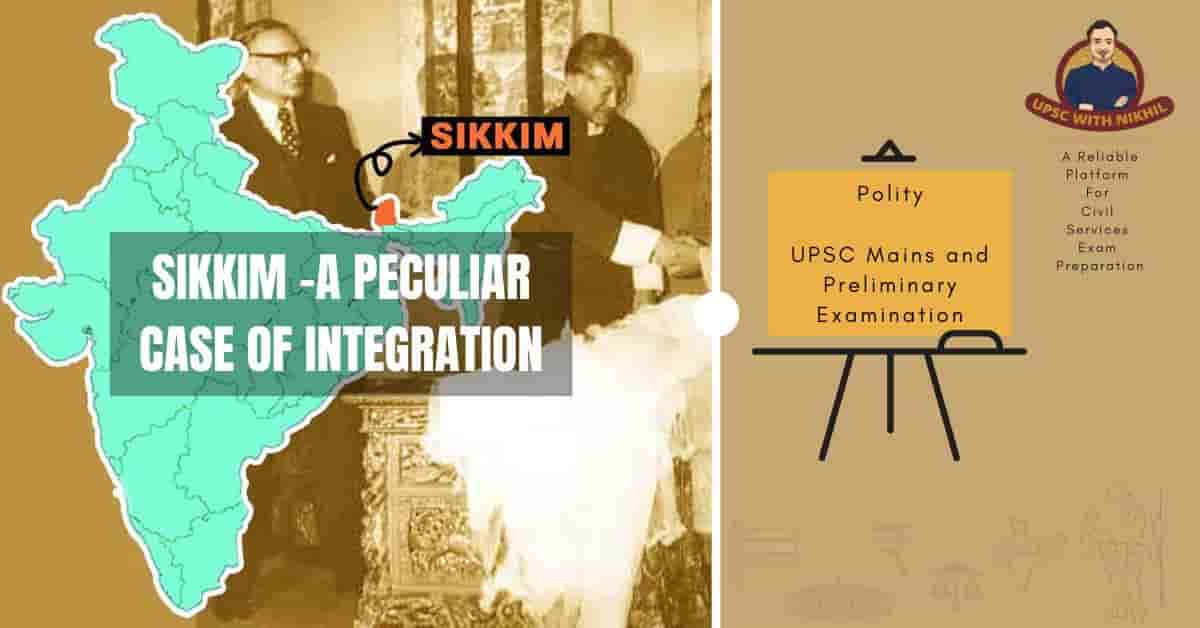
HOW SIKKIM BECAME THE PART OF INDIA?
In the Limbu language, the word 'Sikkim' literally means "new palace." Sikkim was a small Buddhist kingdom with strong religious and cultural ties to Tibet in the past. It has been ruled by its hereditary monarch, Chogyal, since the 17th century. It was a British Protectorate subject to British Paramountcy from 1886 onwards, so its position was similar to that of other princely states in India.

When India gained independence in 1947, a popular referendum in Sikkim rejected joining the Indian Union. However, those were the days in China when communists rose to power. When China's People's Liberation Army invaded Tibet in 1950, India protested vehemently but was powerless to stop it. Nehru rushed through a series of defence treaties with Bhutan (August 1949), Nepal (July 1950), and Sikkim as China neared victory in Tibet (Dec ember, 1950). Nehru's definition of a redrawn security zone included these countries. Throughout the 1950s, Nehru tried to show that he was serious about the Himalayan doctrine. Nehru formed the North and North-Eastern Defence Committee in February 1951 and paid visits to the North-East Frontier Agency (NEFA), Sikkim, and Bhutan. In summary, Nehru offered Nepal, Bhutan, and Sikkim support in the event of a Chinese invasion. The treaty between India and Sikkim required the kingdom to hand over all of Sikkim's external relations to India, allow Indian troops to be stationed in the kingdom, and prohibit the kingdom from "dealings with any foreign power."
As a result of this treaty, Sikkim was designated as a protectorate, with Chogyal as the Monarch. Chogyal Tashi Namgyal died in 1963, and his son Palden Thondup Namgyal succeeded him. There was, however, a growing schism between the people and the Namgyals. The Namgyals wanted full sovereignty, but the majority of the state's citizens, including some local political parties, wanted the monarchy removed and a democratic system in place, as well as accession to the Union of India. In 1973, this culminated in widespread agitation against the Sikkim Durbar. These protests resulted in the administration's complete collapse.
On May 8, 1973, the Chogyal, the Government of India, and the political leaders of Sikkim signed a historic agreement acknowledging the importance of the people in the affairs of Sikkim. The Sikkim Assembly passed the Government of Sikkim Act, 1974, in 1974, paving the way for Sikkim's first ever responsible government and seeking representation in India's political institutions. In addition, India passed the 35th Amendment Act of 1974, which added a new article 2A, titled "Sikkim to be associated with Union," and a 10th schedule.

Making Sikkim an associate state of the Union, on the other hand, would have set a bad precedent in the long run. Another anomaly was the exclusion of Sikkim MPs from voting in the presidential and vice-presidential elections. In 1975, Sikkim's Prime Minister, KaziLhendupDorjee, petitioned the Indian Parliament to change Sikkim's status so that it could become a state of India. The Indian Army took over Gangtok in April of that year and disarmed the Palace Guards. Then, in 1975, a referendum approved the abolition of the monarchy and the complete merger of Sikkim with India with around 97 percent of the vote. In western, Chinese, and communist media, the referendum has sparked debates, criticism, and conspiracy theories, with some calling it an illegal annexation.
The referendum was followed by the Thirty-sixth Amendment Act, 1975, which amended the Indian Constitution yet again. Article 2-A and the Xth Schedule were repealed, and Sikkim was added to the Constitution's first Schedule as a state. Sikkim became India's 22nd state on April 26, 1975, as a result of this. Every year on the 16th of May, Sikkim celebrates its State Day, which commemorates the day when the first Chief Minister of Sikkim took office.
TENTH SCHEDULE OF INDIAN CONSTITUTION-PRESENT STATUS
The 10th Schedule was omitted in the 36th Amendment, but it was later reintroduced as the Anti Defection Law in the 52nd Amendment Bill of 1985. Article 371 of the Constitution protects Sikkim's Special Provisions (F). Part XXI-Temporary, transitional, and special provisions of the Indian constitution mentions safeguards.
CHINA’S STAND ON SIKKIM’S MERGER

China refused to accept Sikkim as an integral part of India for decades after 1975, claiming that the referendum was a farce and that the merger was actually a forcible annexation by India. It continued to issue maps depicting Sikkim as a sovereign state.
China, on the other hand, removed Sikkim from its website of Independent Asian countries for the first time in 2003.
At the time, China was the only country that did not recognise Sikkim as an Indian state.
China had previously stated that it would recognise Sikkim as part of India in exchange for full recognition of Tibet as part of China by India.
India and China agreed to begin border trade through Nathu La Pass in Sikkim and Tibet after signing a memorandum of understanding. China's acceptance of Nathu La as an Indian trade point was interpreted by India as approval of Sikkim's recognition as an integral part of India. Sikkim "is no longer an issue in India-China relations," according to a joint statement issued in 2005 during the visit of Chinese Premier Wen Jiabao to India.