

The Assam Accord
HISTORY OF THE ASSAM ACCORD
The influx of immigrants was a major source of concern for Assamese residents. Around Partition and in the run-up to the Bangladesh war in 1971, the state experienced two major episodes of large-scale migrant influx. Illegal immigration continued to flow across porous borders, and the issue gained prominence when the voter list for a 1978 by-election to the Mangaldoi Lok Sabha seat saw a surge. The All Assam Students Union (AASU) has called for the election to be postponed until 'foreigner names' are removed from the electoral rolls. The All AsomGana Sangram Parishad (AAGSP) and the AASU began a series of protests across the state in 1979. For a long time, state educational institutions were closed. Periodic strikes became violent at times. The agitation claimed the lives of 860 people, according to official records. The Assam Accord was the culmination of a six-year agitation that began with this event.
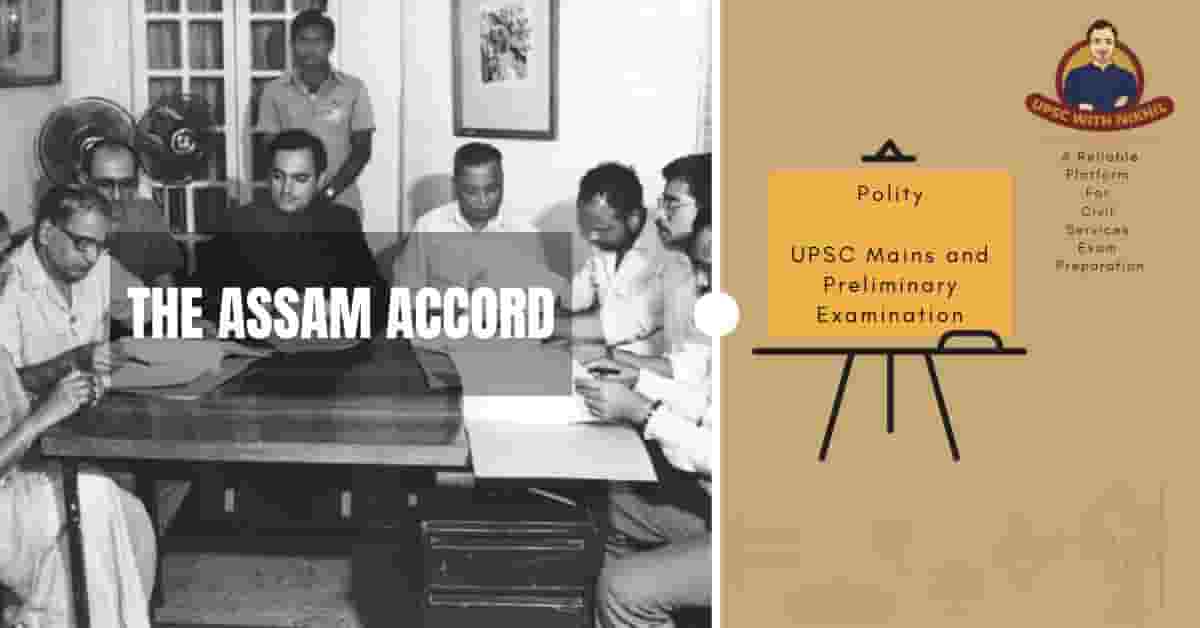
The Assam Accord was signed in 1985 by the Centre, the Assam government, Aasu, and the AAGSP to put an end to the agitation over foreigners. Foreigners were to be divided into the following categories under the Accord and subsequent amendments to the Citizenship Act:

a) Those who arrived in Assam before January 1, 1966;
b) Those who arrived between January 1, 1966, and December 31, 1971;
c) Those who arrived in Assam on or after the 25th of January, 1997.
Other provisions of the agreement included:
Restricting acquisition of immovable property by foreigners
Registration of births and deaths
Prevention of encroachment of government lands
Promoting cultural, social, linguistic identity and heritage of Assamese
Economic development, stress on education, science and technology
Only central authorities will be able to issue citizenship certificates.
Border security to be ensured
The Citizenship (Amendment) Act of 1985 added the following special provisions relating to citizenship of persons covered by the Assam Accord (which concerned foreigners):
(a) As of the 1st January, 1966, all persons of Indian origin who came to Assam from Bangladesh before that date and who have been ordinarily residents in Assam since that date are deemed to be citizens of India.

(b) Every person of Indian origin who came to Assam from Bangladesh on or after January 1, 1966, but before March 25, 1971, and who has been ordinarily resident in Assam since the date of his entry, and who has been detected as a foreigner, must register. For all purposes, such a registered person shall be deemed to be an Indian citizen as of the expiration of a ten-year period from the date of detection as a foreigner. However, he will have the same rights and obligations as an Indian citizen for the next ten years, with the exception of the right to vote.
WHAT IS THE MEANING OF NATIONAL REGISTER OF CITIZENS (NRC)?
The National Register of Citizens (NRC) is a database that contains information about every Indian citizen. The National Register of Citizens (NRC) was created after the 1951 Census was completed, and it contained information on all of the people who were counted.
Following the 1951 Census, a National Register of Citizens (NRC) was prepared for each village, showing the houses or holdings in serial order and indicating the number and names of persons staying therein, as well as the father's/mother's/name, husband's nationality, sex, age, marital status, educational qualification, means of livelihood or occupation, and visible identification mart. This was accomplished by copying the specifics recorded during the 1951 Census into registers. The Ministry of Home Affairs directed the preparation of this NRC (MHA).
According to instructions issued by the Government of India in 1951, these registers covered every person enumerated during the Census of 1951 and were kept in the offices of Deputy Commissioners and Sub Divisional Officers. In the early 1960s, these registers were transferred to the Police Department.
NRC Updation
The register containing the names of Indian citizens is known as the National Register of Citizens (NRC). The process of enlisting the names of citizens based on Electoral Rolls up to 1971 and 1951 NRC is known as NRCupdation. In other words, the process of enlisting the names of those persons (or their descendants) whose names appear in any of the Electoral Rolls up to 1971, 1951 NRC, or any of the admissible documents stipulated is known as National Register of Citizens (NRC) updation. The Citizenship Act of 1955 and the Citizenship (Registration of Citizens and Issue of National Identity Cards) Rules of 2003 will be used to update the NRC. As a result, eligibility for inclusion in the updatedNRC will be determined using the NRC, 1951, Electoral Rolls up to midnight on March 24, 1971, or the list of admissible documents issued up to midnight on March 24, 1971, whichever comes first.
WHO ARE ELIGIBLE FOR INCLUSION IN ASSAM?
a) Individuals whose names appear in the NRC from 1951
b) Individuals whose names appear on any of the Electoral Rolls prior to March 24, 1971 (midnight).
c) Descendants of the above-mentioned individual
d) Persons who arrived in Assam on or after January 1, 1966, but before March 25, 1971, and registered with the ForeignersRegistration Regional Officer (FRRO) in accordance with the Central Government's rules, and who have not been declared as illegal migrants or foreigners by the competent authority.
e) ‘D' voters can apply to have their names added to the updated NRC. Their names, on the other hand, will be remembered. Only when the appropriate Foreigner Tribunal declares them non-foreigners are they finally included.
f) Persons who can provide any of the documents listed in the list of documents admissible for citizenship that were issued before midnight on March 24, 1971.
D voter, also known as dubious voter or doubtful voter, is a group of Assamese voters who have been disenfranchised by the government due to an alleged lack of proper citizenship credentials.
According to the Supreme Court's most recent order,
On producing satisfactory proof of residence in any part of the country (outside Assam) as of March 24, 1971, all Indian citizens, including their children and descendants, who moved to Assam after March 24, 1971, would be eligible for inclusion in the updated NRC.
All members of the Tea Tribes will be covered by the category of "Original inhabitants of Assam" established by Clause 3(3) of the Schedule of the Citizenship (Registration of Citizens and Issuance of National Identity Cards) Rules, 2003.
On the basis of proof to the satisfaction of the Registering Authority, all such original inhabitants shall be included. Their names will be added to the updated NRC once their citizenship has been established beyond a reasonable doubt.
NRC is a positive step

Despite these criticisms, the NRC's revision is a positive step in a number of ways.
To begin with, once the draught is finalised, it will provide a much-needed perspective on the scope of illegal migration into Assam, and the country as a whole. There have been wild speculations about the actual number of illegal Bangladeshi immigrants since the days of the Assam agitation against them. The lack of official estimates added to the uncertainty about the number of illegal migrants. This allowed political parties to exaggerate statistics, polarise voters, and use the issue to gain electoral advantage. Such speculations are likely to be put to rest if the NRC is updated, as it will provide a verified dataset on which to hold meaningful debates and implement calibrated policy measures.
Second, since independence, the issue of illegal migrants has remained a contentious one in Assam. It even caused a split in opinion between successive central and state governments, with the former continuing to be accommodating to migrants, referring to the mass migration from East Pakistan as "homecoming." To the dismay of Assamese citizens, some central leaders went so far as to deny that any illegal migration from Bangladesh had occurred in the state. The release of an updated NRC will vindicate the long-held belief of large sections of the Assamese population that unrestricted infiltration from Bangladesh has occurred, disrupting the demographic profile of the state's population, particularly in border districts. They point out that this has resulted in fierce competition and conflict between indigenous peoples and migrants for resource access.
Finally, the release of an updated NRC is expected to deter future Bangladeshi migrants from illegally entering Assam. The draught NRC has already created the impression that staying in Assam without valid documentation will result in detention, imprisonment, and deportation. More importantly, illegal migrants may have a harder time obtaining Indian identity documents and obtaining all of the rights and benefits that all Indian citizens enjoy. Last but not least, their inclusion in the NRC will provide relief to all Bengali-speaking Assamese who have previously been suspected of being Bangladeshis.