

The Darker Side Of Rule Of Law
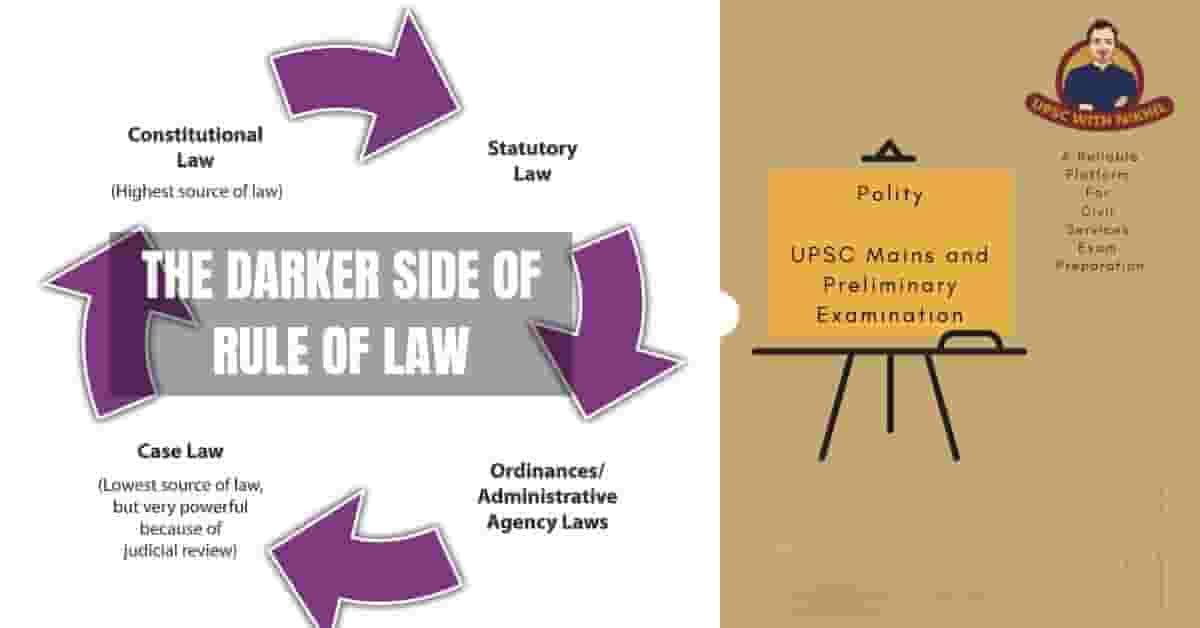
When it comes to the rule of law, the case of ADM Jabalpur vs Shiv Kant Shukla is one of the most important. The court was asked in this case whether there was any rule of law in India other than Article 21. This was in the context of the suspension of Articles 14, 21, and 22 enforcement during the declaration of an emergency. For the legal question, the majority of the bench answered in the negative.
However Justice H.R. Khanna dissented from the majority opinion and observed that “Even in absence of Article 21 in the Constitution, the state has got no power to deprive a person of his life and liberty without the authority of law. Without such sanctity of life and liberty, the distinction between a lawless society and one governed by laws would cease to have any meaning…” The majority of judges were unable to take a firm stance and interpreted the supremacy of law to mean supremacy of the law of the land rather than supremacy of the constitutional spirit, or rule of law.
However Justice H.R. Khanna dissented from the majority opinion and observed that “Even in absence of Article 21 in the Constitution, the state has got no power to deprive a person of his life and liberty without the authority of law. Without such sanctity of life and liberty, the distinction between a lawless society and one governed by laws would cease to have any meaning…” The majority of judges were unable to take a firm stance and interpreted the supremacy of law to mean supremacy of the law of the land rather than supremacy of the constitutional spirit, or rule of law.

The issue of the judiciary's encroachment on other government organs in the name of activism is always present. The extent to which the courts can limit the power of other organs is a question that needs to be considered. The principle of the rule of law also prohibits the judiciary from conferring power on itself. The court's interpretations and judgments are never sufficient to ensure Rule of Law observance. Corruption, phoney encounters, and unjust policies all work against the rule of law.
The word 'equality' comes to mind when thinking about the concept of rule of law. This, too, has been widely panned. The government has the inherent power to act solely on its own initiative and without regard for checks or limitations. In general conditions, total equality is possible to achieve, not only in India but in any country. For example, in India, no case can be brought against bureaucrats and diplomats, and members of parliament have special privileges when it comes to legal actions against them.
The Supreme Court of India has broadened the scope of Article 21 to include the right to bail, a speedy trial, immunity from cruel and inhuman punishment, the right to dignified treatment in detention facilities, the right to legal assistance in criminal proceedings, and, most importantly, the right to live with basic human dignity. It has also established new doctrines such as the public trust doctrine, the doctrine of promissory estoppel, the doctrine of absolute liability, and a slew of other principles such as the polluter's pay principle, among others, and provided guidance in cases where no legislation existed, such as sexual harassment at work, and most importantly, laid the groundwork for Public Interest Litigation. The vast jurisprudence developed by the courts ensures that the state is bound by its welfare functions and that no one's rights are abridged by the hand of a tyrant.

Any act, inaction, or abuse of such powers by one organ necessitates the intervention of the other. Even if such laws are passed by Parliament, judges are not to act on laws that are against humanity, based on unreasonable classification, arbitrary in nature, or against moral principles. They are to bring in law interpretations that are consistent with the Constitution's principles. However, the judiciary has been tainted by corruption in the past, and in order to combat judicial corruption, it is necessary to keep the judiciary independent of legislative and executive control. There is also a requirement for a quick justice system.
Similarly, Parliament must ensure that the laws it passes do not violate the rule of law, the Constitution, or public morality and humanity. It should also keep an eye on social changes and scientific progress from time to time to ensure that the laws are up to date. Article 105(2) of the Constitution needs to be changed because it encourages and protects corruption or horse trading in Parliament, which is incompatible with democracy and the rule of law. The Executive should also refrain from enforcing laws that are contrary to natural justice, or that violate the rights, liberties, and freedoms of ordinary people, or that are contrary to the state or constitution in general. This is the doctrine of self-restraint, in which all organs strive to meet the nation's aspirations and uphold the rule of law without interfering with one another's domain.
The Constitution must always be considered supreme, and the legislature's laws must pass the test of reasonableness and conform to the Constitution's goals. If any government organ oversteps its bounds, encroaches on the powers of other organs, or exceeds its jurisdiction, the act will be declared invalid, and any abuse of law or action will be declared void ab initio, and the principle of checks and balance will be invoked to ensure the rule of law is maintained.