

The Presiding Officer Of The Lok Sabha
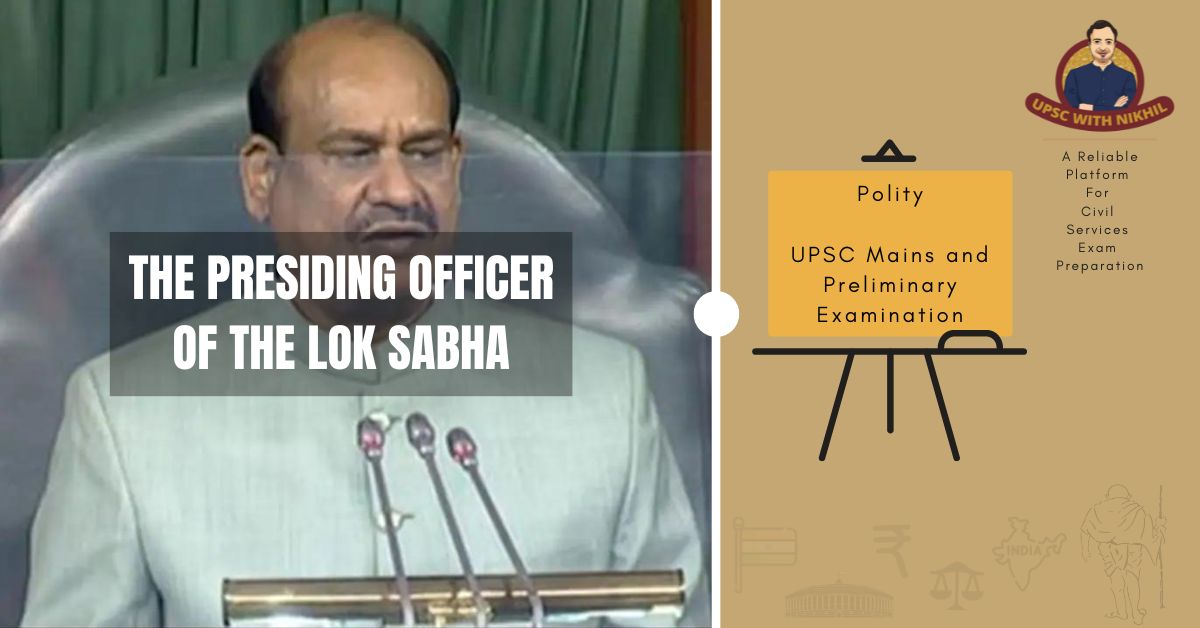
The presiding officer of each House of Parliament is different. The Lok Sabha has a Speaker and a Deputy Speaker, whereas the Rajya Sabha has a Chairman and a Deputy Chairman. The Lok Sabha has a panel of chairpersons, and the Rajya Sabha has a panel of vice-chairpersons.
How Speaker of Lok Sabha is Elected and Removed?
Election and Tenure: The Lok Sabha elects the Speaker from among its members (as soon asmay be, after its first sitting). When the Speaker's office becomes empty, the Lok Sabha elects a new member to replace the vacancy. The President sets the date for the Speaker's election. The Speaker of the Lok Sabha usually serves for the whole term of the Lok Sabha.

In any of the following three situations, he must quit his office sooner:
• if he is no longer a Lok Sabha member;
• if he submits a letter of resignation to the Deputy Speaker; and
• if he is removed from office by a resolution passed by a majority of the Lok Sabha members. Only 14 days' notice is required for such a resolution to be moved.
When the House is considering a resolution to remove the Speaker, he is not allowed to preside over the meeting, even if he is present. He can, however, speak and participate in House proceedings at that time, as well as vote in the first instance, though not in the case of a tie vote. It's worth noting that when the Lok Sabha is dissolved, the Speaker does not step down and remains in office until the newly-elected Lok Sabha convenes.
What is The Role, Powers and Functions of a Speaker?
The Speaker's role, powers, and functions are as follows:
The Speaker is the head and representative of the Lok Sabha. He is the keeper of the members' powers and privileges, as well as those of the House as a whole and its committees. He is the House's primary spokesman, and his decisions are final in all Parliamentary matters. As a result, he is much more than the Lok Sabha's presiding officer. He is entrusted with broad, varied, and crucial tasks in these positions, and he enjoys great honour, high dignity, and supreme authority inside the House. The Speaker of the Lok Sabha gets his rights and responsibilities from three places: the Indian Constitution, the Lok Sabha Rules of Procedure and Conduct of Business, and Parliamentary Conventions (residuary powers that are unwritten or unspecified in the Rules). He has the following powers and responsibilities in total:

He is in charge of maintaining order and decorum in the House in order to conduct business and regulate proceedings.
This is his main responsibility, and he has the last say in the matter.
Within the House, he is the final interpreter of the provisions of (a) the Indian Constitution, (b) the Lok Sabha Rules of Procedure and Conduct of Business, and (c) parliamentary precedents.
In the lack of a quorum, he adjourns or suspends the meeting. A quorum of one-tenth of the House's total strength is required to convene a meeting.
In the first instance, he does not vote. In the event of a tie, he can cast the deciding vote. In other words, the Speaker is only allowed to vote when the House is evenly divided on any issue. This type of vote is known as a casting vote, and it is used to break a tie.
He is the Speaker of the House of Commons, and he preside over a combined sitting of the two Houses of Parliament. The President calls such a meeting to break a deadlock between the two Houses on a bill.
On the Leader of the House's request, he can allow a'secret' sitting of the House. When the House meets in secret, no one can enter the chamber, lobby, or galleries without the Speaker's consent.
He is the one who determines whether a bill is a money bill or not, and his decision is definitive. When a money bill is sent to the Rajya Sabha for consideration and then given to the President for approval, the Speaker signs his certificate on the bill stating that it is a money bill.
He decides whether or not a member of the Lok Sabha should be disqualified for defection under the provisions of the Tenth Schedule. The Supreme Court declared in 1992 that the Speaker's decision on this matter is amenable to judicial review.
He serves as the ex-officio head of the Indian Parliamentary Group, which serves as a link between the Indian Parliament and other world parliaments. He also serves as ex-officio head of the country's conference of presiding officers of legislative bodies.
He appoints the chairperson of all Lok Sabha legislative committees and oversees their operations. The Business Advisory Committee, the Rules Committee, and the General Purpose Committee are all chaired by him.
Independence and Impartiality: Because the Speaker's office carries such a high level of reputation, power, and authority, independence and impartiality are a must. The Speaker's office is guaranteed to be independent and impartial by the following provisions:

He is guaranteed a job for the rest of his life. He can only be dismissed if the LokSabha passes a resolution with an absolute majority (i.e., a majority of the total members of the House) rather than an ordinary majority (ie, a majority of the members present and voting in the House). Only when this motion for removal obtains the support of at least 50 members can it be examined and discussed.
His remuneration and benefits are set by Parliament. They are deducted from the Consolidated Fund of India, and hence are not subject to yearly Parliamentary approval.
In the Lok Sabha, his work and behaviour can only be reviewed and criticised on the basis of a substantive motion.
His powers to regulate procedure, conduct business, and maintain order in the House are not subject to any Court's jurisdiction.
In the first case, he is unable to vote. In the event of a tie, he can only use his casting vote. As a result, the Speaker's position is neutral.
In the order of precedence, he is assigned a very high rank. Along with the Chief Justice of India, he is ranked eighth. This means that, with the exception of the Prime Minister and Deputy Prime Minister, he has a higher rank than all cabinet ministers.
The Speaker of the House of Commons in the United Kingdom is strictly a non-party figure. It is customary for the Speaker to resign from his political party and remain politically neutral. In India, where the Speaker does not withdraw from his party membership upon election to the elevated post, this healthy convention is not fully established.