

Vice-president Of India
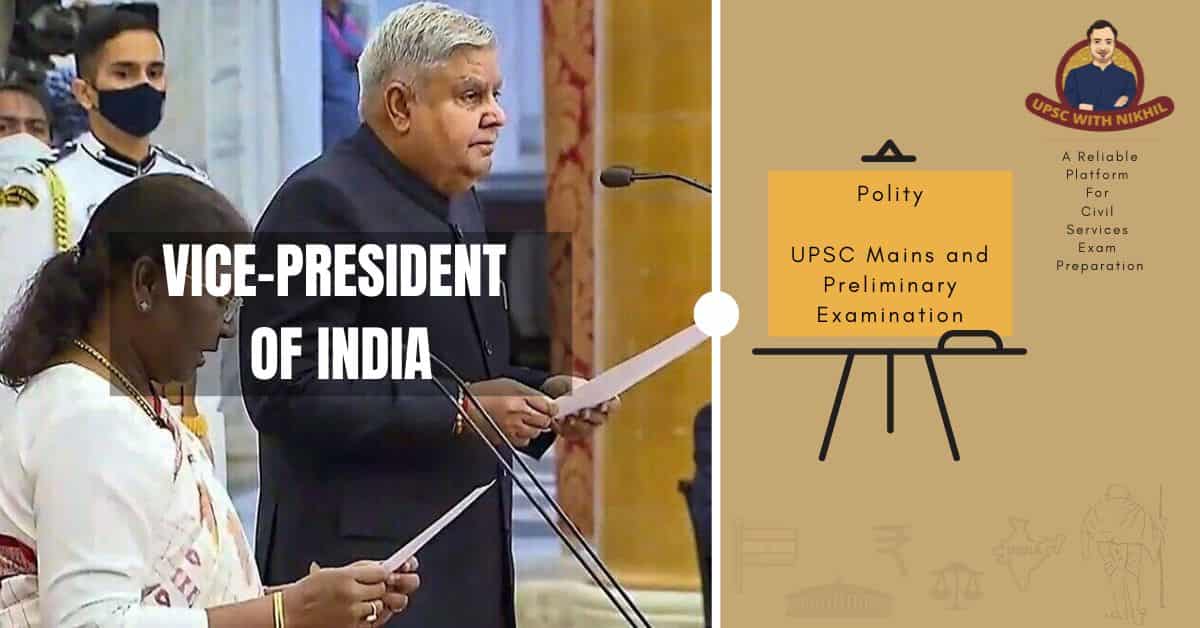
The Vice-President is the country's second-highest official. In the official warrant of precedence, he is ranked next to the President. The Vice-Presidential Office is modelled after the American Vice-Presidential Office.
How Vice-President Is Elected?

The Vice-President, like the President, is chosen indirectly by the people rather than directly by the people. Members of an electoral college comprised of members of both Houses of Parliament elect him. In the following two ways, this Electoral College differs from the Electoral College for the election of the President:
1. It is made up of members of Parliament who are both elected and nominated.
2. Members of state legislative assemblies are not included.
The Vice-Presidential election, like the Presidential election, is conducted using a proportional representation system based on a single transferable vote, with secret ballot voting.
What Are The Qualifications For Election As Vice-President?
A person must meet the following requirements to be eligible for election as Vice-President:
1. He must be an Indian citizen.
2. He should have reached the age of 35.
3. He must meet the requirements to be elected to the Rajya Sabha.
4. He should not hold a profit-making position in the federal government, a state government, a local government, or any other public authority.
However, a sitting President or Vice-President of the United States, a governor of any state, or a minister for the Union or any state are not considered to hold any profit-making office and are thus ineligible to run for Vice-President.
Furthermore, the nomination of a candidate for Vice-President must be supported by at least 20 proposers and seconders. Every candidate must deposit Rs. 15,000 in the Reserve Bank of India as a security deposit.
What Is The Term Of Office Of Vice President?
The Vice-President is elected for a five-year term that begins on the date he takes office. He can, however, resign from his position at any time by writing a letter to the President. He can also be fired from his job before the end of his term. His removal does not require a formal impeachment. He can be removed from office if the Rajya Sabha passes a resolution with an absolute majority (i.e., a majority of the total members of the House) and the Lok Sabha agrees. However, such a resolution cannot be moved unless at least 14 days' notice is given. Notably, there is no basis for his removal in the Constitution.

The Vice-President can stay in office beyond his five-year term until his successor takes over. He's also up for re-election to that position. He can be re-elected for as many terms as he wants.
Conditions Of Office
The Vice-office President's is subject to the following two conditions, as laid out in the Constitution:
1. He should not be a member of either the House of Commons or the House of States. If one of these people is elected Vice-President, he is deemed to have vacated his seat in the House on the day he takes office as Vice-President.
2. He should not hold any other profit-generating position.
Emoluments
The Vice-emoluments President's in that capacity are not specified in the Constitution. In his capacity as ex-officio Chairman of the Rajya Sabha, he receives a regular salary. The salary of the Chairman of the Rajya Sabha was increased by the Parliament in 2008 from 40,000 to 1.25 lakh per month. He is also entitled to a daily allowance, a free furnished apartment, medical, travel, and other benefits.
During any period when the Vice-President acts as President or performs the functions of the President, he is entitled to the President's salary and allowance rather than the Chairman's salary and allowance.
Vacancy In Office
A vacancy in the Vice-office President's can arise for a variety of reasons:
1. when his five-year term came to an end.
2. because of his resignation
3. on his deportation
4. because of his death
5. If he is disqualified to hold office or his election is declared null and void, for example.
When a vacancy arises as a result of the term of the current vice-president expiring, an election to fill the vacancy must be held before the term expires. If the office becomes vacant due to resignation, removal, death, or any other reason, an election to fill the vacancy should be held as soon as possible. From the time he takes office, the newly-elected vice-president serves for a full five-year term.
Who Settles The Election Disputes Of Vice President?
All doubts and disputes about the Vice-Presidential election are investigated and decided by the Supreme Court, whose decision is final. The election of a Vice President cannot be called into question because the Electoral College was insufficient (i.e., existence of any vacancy among the members of Electoral College). If a person's election as Vice President is declared void by the Supreme Court, acts performed by that person prior to the date of the Supreme Court's declaration are not invalidated (i.e., they continue to remain in force).
What Are The Powers And Functions Of Vice-President?

The Vice-responsibilities President's are twofold:
1. He is the Rajya Sabha's ex-officio Chairman. His powers and responsibilities are similar to those of the Speaker of the Lok Sabha in this capacity. In this way, he resembles the American vice-president who also serves as Chairman of the Senate, the American legislature's upper house.
2. When the President's office becomes vacant due to his resignation, removal, death, or other reasons, he acts as President. He can only serve as President for a maximum of six months before a new President must be elected. Furthermore, when the President is unable to perform his duties due to absence, illness, or any other reason, the Vice-President takes over until the President is able to resume his duties.
The Vice-President does not perform the duties of the Chairman of the Rajya Sabha while acting as President or discharging the functions of the President. During this time, the Rajya Sabha's Deputy Chairman is in charge of those responsibilities.
Though the Indian Vice-office President's is similar to that of the American Vice-President, there are some differences. When the presidency of the United States becomes vacant, the Vice President takes over and serves for the remainder of his predecessor's term. The Indian Vice-President, on the other hand, does not take over as President when the position becomes vacant for the remainder of the term. He only serves as President-in-waiting until the new President takes office.
The Constitution clearly assigns no significant function to the Vice-President in that capacity, as evidenced by the above. As a result, some scholars refer to him as "His Superfluous Highness." This office was established in order to ensure the Indian State's political continuity.