

India's Rural Education: An Outline
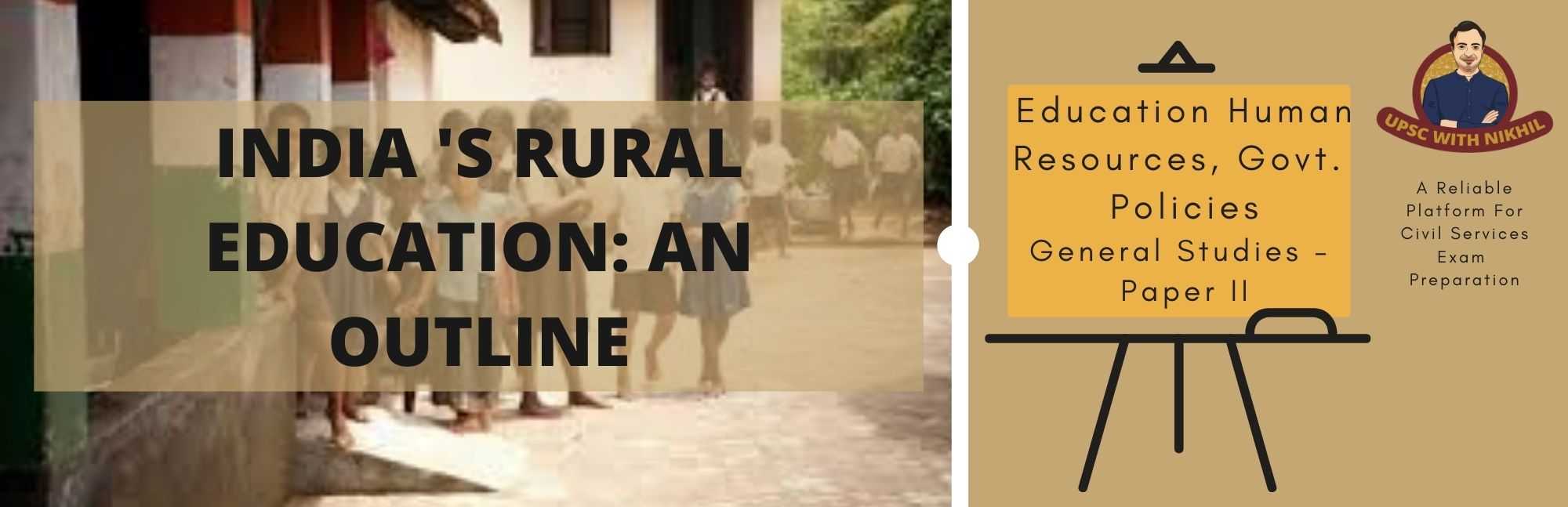
While India's literacy rate has shown solid growth in recent years, it has not been able to deliver the kind of education that modern times demand. If the rural education sector of a nation performs well, it represents the whole economic condition of the country.
Introducing:
Mahatma Gandhi once said, "India lives in her villages." And the remark made by the Father of the Nation many decades ago still seems to hold true even after fast-paced urbanisation in India. Rural populations as a percentage of the total population in India were registered at 66.46 percent in 2017, according to World Bank statistics collected from officially recognised sources.
Speaking of literacy, the level of education is not only a reflection of a society's level of progress, but also an incentive for the growth and modernization of society. As a result, the government's primary objective of promoting rural education is to ensure an overall balance in growth.

Rural Education Status in India:
As per Census 2011, literacy rate in rural areas was around 68 per cent while it was 84 per cent in urban areas. Furthermore, only 59 per cent of rural women were estimated to be literate as compared to nearly 80 per cent urban women being literate in 2011. Some interesting findings have been thrown up by the survey on 'Social Consumption: Education' during the National Sample Survey (NSS) 71st Round, brought to light several ground level realities of education in rural India vis a vis urban India which are of relevance to a policy maker.
¡ The survey found that literacy rates in rural India were much lower in comparison to urban India across different age groups.
¡ While overall literacy rate among persons (aged 5 years and above) in India was 76 per cent, in rural areas it was 71 per cent compared to 86 per cent in urban areas.
¡ In both rural and urban areas, more than 90 per cent per cent households reported availability of primary school within 1 km from the house as per the survey.
¡ In rural areas, the major reason for 'never-enrolment' for persons of ages 5-29 years was 'not interested in education' (33 per cent male and 27 per cent female) while in urban areas, nearly 33 per cent males and 30 per cent females in the age group of 5-29 years never enrolled because of 'financial constraints'.
¡ The survey showed that nearly 6 per cent of rural households and 29 per cent of urban households possessed a computer. Among households with at least one member of age 14 years and above, nearly 16 per cent among rural households had internet access as compared to 49 per cent urban households. Among persons of age 14-29 years, nearly 18 per cent in rural areas and 49 per cent in urban areas were able to operate a computer.
¡ As per Unified District Information System for Education (U-DISE) 2016-17, total number of schools in India were 15.3 lakhs out of which nearly 12.97 lakh schools were in rural areas. Total enrolment in schools was 25.13 crore out of which 18.02 crore was enrolment of students from rural areas.
This data pertains to all the schools from Class I to Class XII across the country. Therefore, rural areas account for 84.46 per cent of total schools in India and 71.72 per cent of total student enrolment in India. In addition, 73.04 per cent teachers are placed in rural locations.
INDIAN RURAL EDUCATION CHALLENGES:
Small Number of Schools: Literacy in rural areas was 64.7 percent, as opposed to 79.5 percent in urban areas in 2018, according to the Ministry of Human Resource Development. The rural regions are struggling with the aim of providing education because there is a shortage of colleges. In addition, the problem is compounded further by inadequate transport and communication. Parents are now unable to send their kids to college. It serves as a major barrier to education.
Lack of financial resources: Poverty continues to be a significant social problem, and rural India is more affected by it. Owing to financial restrictions, children are unable to afford schooling. For most rural households, private schools are a costly and out-of-budget choice. With the little resources they have, they can either educate kids or lead a simple life.
Bad Infrastructure: Bad infrastructure bogs down rural schools. The teacher-student ratio is extremely imbalanced to begin with. The new teachers are not even well-trained. Of course, this impacts the standard of education being offered. Also basic services are not adequate, such as textbooks, drinking water, and libraries.
Traditional Teaching Way: While pedagogy has increased many notches in urban areas with the advent of modern teaching techniques, these remain primitive and traditional in Indian villages. The urban schools have embraced the learning of principles, but the rural ones are still stuck to rote.
Lack of Technology: Rural schools are still deprived of technology and improved methods in the 21st century. For every child, basic computer literacy is a must. In rural India, however, schools often don't have computers or teachers to take up the subject. A digital divide in our nation is triggered by this alienation.
Rural-Urban Divide: Disparity in teaching methods, varying magnitude of subjects and topics taught means that rural and urban education are very different.
Parents' Ignorance: In rural schools, the dropout rate is high. Around 50 percent of learners drop out of school before the 12th grade is completed. All of this clearly shows that the situation of first generation learners is rather troubling and undoubtedly requires the government's attention.
STRATEGIES TO ENCOURAGE:
Equitable Education
In rural India, there are many areas that are still bogged down by poverty , poor health, hunger, unemployment and inequality. While the government has worked to alleviate the conditions and some successes have been reported, we still need to travel a long path. And, in that direction, the state is taking the right steps. The different areas on which it is important to concentrate are:
Teacher availability: The teacher is key to successful education; education is the process between the teacher and the student at its heart. Teaching needs to improve if education is to improve. Any initiative to reform must understand the teacher's centrality.
Teaching is a discipline that is intellectually and ethically rigorous. With regard to their professional identity and expertise, teachers must be seen as autonomous, competent, and responsible professionals.
Trained Teachers: The first and foremost thing is to train each non-permanent teacher named recently. Student psychology should be understood by expert teachers, and they will be able to properly control and develop their pupils. Therefore, the first step should be to train teachers to ensure that the most basic requirements can be met.
Decentralization in school management: There is no question that the secret to repairing and reviving the dysfunctional rural education governance structure in India is decentralisation in school / college administration and governance. In this regard, in order to revive and improve the standard of education in rural areas of the country, the position of local bodies and self-help groups is most crucial.
Rural Connectivity: Due to the difficulties of getting there, most students and teachers opt out of classes. There are no simple railway links in rural areas , which makes travelling a strenuous operation. Of course, investments in the rail networks in rural areas would strengthen the education systems.
Student Incentives: The mid-day meal is a perfect opportunity to go to school for students from disadvantaged backgrounds. More of these programmes should be built by the government to cater to students so that they have a reason to go to school every day.
Proper Toilets and Sanitation: The expression 'A sound mind in a sound body' is understood to all. In any school, proper toilets and sanitation are an absolute necessity. The availability of adequate toilets for girls and boys would only help to increase the number of school students.
Digitalization of education: Digital literacy is an important part of education, especially in a world where technological advancement is the flag bearer of change. The focus is not only on infrastructure, but also on quality and creative solutions through technology to enhance educational delivery systems. The student population has shown tremendous enthusiasm for studying e-Resources. This holds great promise for the future, as internet penetration grows and rural and far-flung areas will be the key beneficiaries of online courses and facilities.
Spread over an enormous landscape, affecting over 18 crore students (71 percent of the students of the nation), over 84 percent of the total schools in India account for the rural school education sector. Despite a rising trend in urbanisation, it is estimated that even in 2050, most of India will still reside in rural regions. Given the ripe demographic potential of the country, rural India 's growth is critical to forge the porgress of htentiaon.
GOVERNMENT RURAL AREAS INITIATIVES:
'Jawahar Navodaya Vidyalayas' expansion,' Samagra Siksha' pan-India expansion and voluminous increase in budget allocations,' Kasturba Gandhi Balika Vidyalayas' expansion,' Mid-Day Meal Scheme' quality improvements,' Unnat Bharat Abhiyan ',' Swachhta Abhiyan ',' Huge Online Courses ',' Eklavya Model Residential School Scheme' expansion, digital initiatives and extreme promotion Although some of the programs/schemes/projects are unique to rural areas, flagship programmes such as 'Samagra Shiksha' are also likely to have a huge effect on the expansion of infrastructure and quality enhancement of teachers in rural areas.
The ambitious programme 'Samagra Shiksha' was launched to encourage comprehensive education, integrating three major initiatives to provide integrated school education from pre-school to higher secondary level: 'Sarva Shiksha Abhiyan (SSA)', 'Rashtriya Madhyamik Shiksha Abhiyan (RMSA)' and 'Teacher Education (TE)'. A big part of this umbrella scheme is the special arrangements for 'Kasturba Gandhi Balika Vidyalayas',' Special Focus Districts (SFDs)',' Educationally Deprived Blocks (EEBs)',' Left Wing Extremism (LWE)' affected districts, etc. The plan also involves measures such as inservice preparation of teachers and school heads, library grants, recreation and physical activity.
CONCLUSION
The government is working around the clock to make meaningful reforms to the country's education system so that learners can obtain world-class education. By equipping its students with the requisite skills and expertise, efforts are being made to make India an information superpower and to eradicate the shortage of staff in science , technology, academia and industry.
The centre and the states are also developing quality infrastructure , especially in the northeastern area, for better educational prospects. The government is especially focused on improving the education infrastructure in the country's rural and backward regions through a wide range of schemes, policies and programmes. The growth of every country depends on the education of its people. The various policies and systems aimed at ensuring education for all reflect the government's commitment to inclusive growth. There are far-reaching effects of the huge initiative in recent times to revamp and extend the education system in India.
EDUCATING TEACHER: PROBLEMS AND REFORMS
The Government of India has set up many committees and commissions to improve the quality of teachers and for their professional development. Teacher education is a process for preparing professional teachers by inculcating necessary knowledge, competence, skills among them for teaching at various stages of school education. In our country, programmes are being conducted in the teacher training institutes and departments of education in the universities for preparing professional teachers
The University Education Commission (1948) recommended that theory and practice of pre-service teacher education must support each other. The theory courses must be flexible and adaptable to local circumstances. The teachers should also be kept active and fresh through in-service education.
The Secondary Education Commission (1952-53) recommended the adoption of new techniques of evaluation and suggested that more capable and intelligent persons should be attracted to the teaching profession. There should be two types of training institutions (i) two years training for those who have taken the school leaving certificate and (ii) one year training for the graduates.
Education Commission (1966) recommended that quality of training institutions and teacher education programme should be improved. A substantial allocation of funds should be made available to UGC for improvement of teacher education in the universities. Another important landmark was setting up of the State Institute of Education (SIE) in 1964 for providing greater coverage and regional specificity in the programmes of in-service education and training of teachers and other education-related personal concerned with primary education.
The National Policy on Education (NPE) and Programme of Action (POA), 1986, 1992 (revised) calls for overhauling the teacher education system. NPE (1986) made three recommendations i.e. (i) teacher education as a continuous process and its pre-service and in-service components inseparable (ii) the need for new programmes of teacher education to meet the thrusts envisaged in policy and (ii) the need for creating new structures and strengthening institutions to concretise the vision of NPE.
In 1990, the Acharya Ramamurti Committee suggested that the training programme should be competency-based and there should be in tegration of theory and practice.
The Yashpal Committee Report (1993) on Learning Without Burden noted "The content of the programme should be restructured to ensure its relevance to the changing needs of school education. The emphasis of these programmes should be on enabling the trainees to acquire the ability for self-learning and independent thinking."
National Curriculum Framework for Teacher Education of NCFTE (2009) suggested to improve the design and Impact greater rigour and professionalism to the teacher education programmes. Justice Verma Commission in 2012 also made many recommendations for improving the professionalism among teachers. The duration of teacher education programmes were increased. NCTE revised the norms and standards of fifteen programmes of teacher education during 2014 for improving quality and standard of teacher education programme in turn to improve the quality of teachers and professional development. In the end, it is concluded that many reforms have taken place in the area of teacher education from time to time in the light of recommendations made by different commissions and committees set up by Government of India for the professional development of teachers and teacher educators.
THE RIGHT TO EDUCATION EFFECTS:
One of the most defining moments in the country has been the Right to Education (RTE) Act. The decision to bring about this law, like all momentous decisions, was also the culmination of deep thinking and earnest efforts over a number of decades to usher in universal education. We have come a long way from 1910 when Gopal Krishna Gokhale requested "Free and Compulsory Primary Education" in India to 2002 when Article 21-A was inserted in India's Constitution declaring that "the State shall provide free and compulsory education to all children between the ages of six and fourteen years in the manner that the State through decide by law."
The Ministry of Human Resources and Development (MHRD) report published in June 2014 shows that the central government has achieved a fair degree of progress in ensuring that the policies outlined in the RTE have been adopted in several countries. One of the RTE's most critical accomplishments has been a rise in enrollment. In 2016, only around 3% of children between the ages of 6-14 were out of school. The very first step towards addressing the malaise of illiteracy is school enrollment. A crucial factor that merits mention here is the 'Swachh Bharat-Swachh Vidyalaya' campaign which has been responsible for creation and maintenance of hygienic sanitation and drinking water facilities in schools. This has culminated in not only enrolling but also remaining in schools up to higher grades than ever for a significant number of female students.
The 2015 Annual Report of the MHRD also shows that the curriculum provision under the RTE Act has been adopted by most states. Approximately 80 per cent of government teachers are technically trained according to the specified criteria, which is a good measure of teaching efficiency.
At the elementary level, the aim of 'entry to education' is more or less considered to be fulfilled and the emphasis is now moving to secondary and higher secondary levels. However, taking into account the difficulties in the actual realisation of the RTE targets, high dropouts and residual (disadvantaged) out-of-school students, continuous efforts at elementary level are also needed.